
Printable English, Math and Science, grades 1 to 8

A whole year of work, printed, with the words to say written in.

English, Math and Science. Eighteen complete courses, seven to ten units in each, four or five documents in every unit, and a test at the end of all of them. This is the material VA Classes tutors teach from, sold as files you print at home.

  • EnglishGrades 1 to 8, 8 courses
  • MathGrades 1 and 2, 2 courses
  • ScienceGrades 1 to 8, 8 courses
from CA$40one course, one payment,
the whole year
Unit 1 freeemailed to you,
no card, no phone call
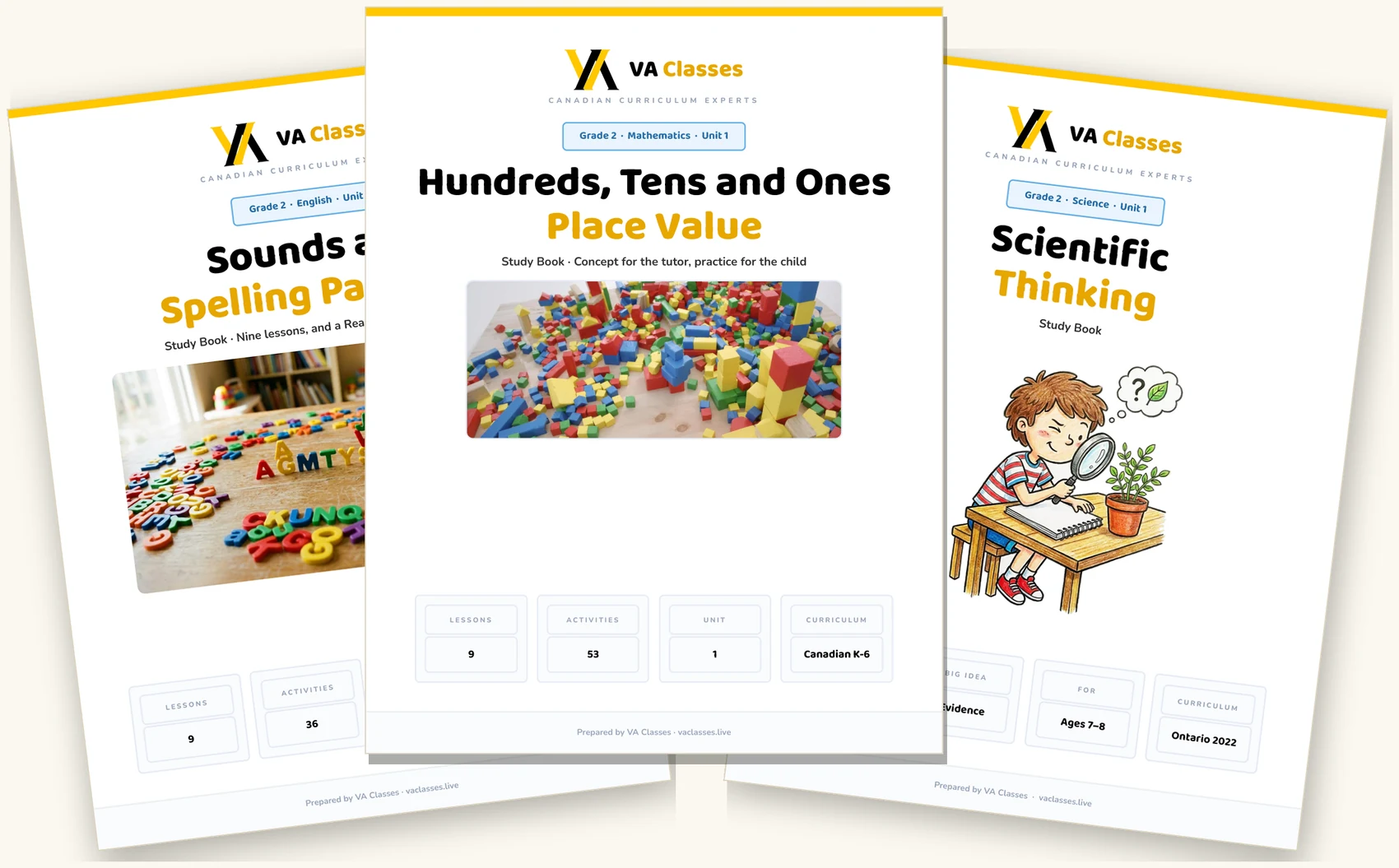
Three Grade 2 Study Books side by side: English, Mathematics and Science
English, Math and Science. One Grade 2 book from each, exactly as they print.
18complete courses
694documents, all printable
11,397pages of work
1118lessons, every one named below

One lesson, nothing left out

This is a lesson. Read it before you decide anything.

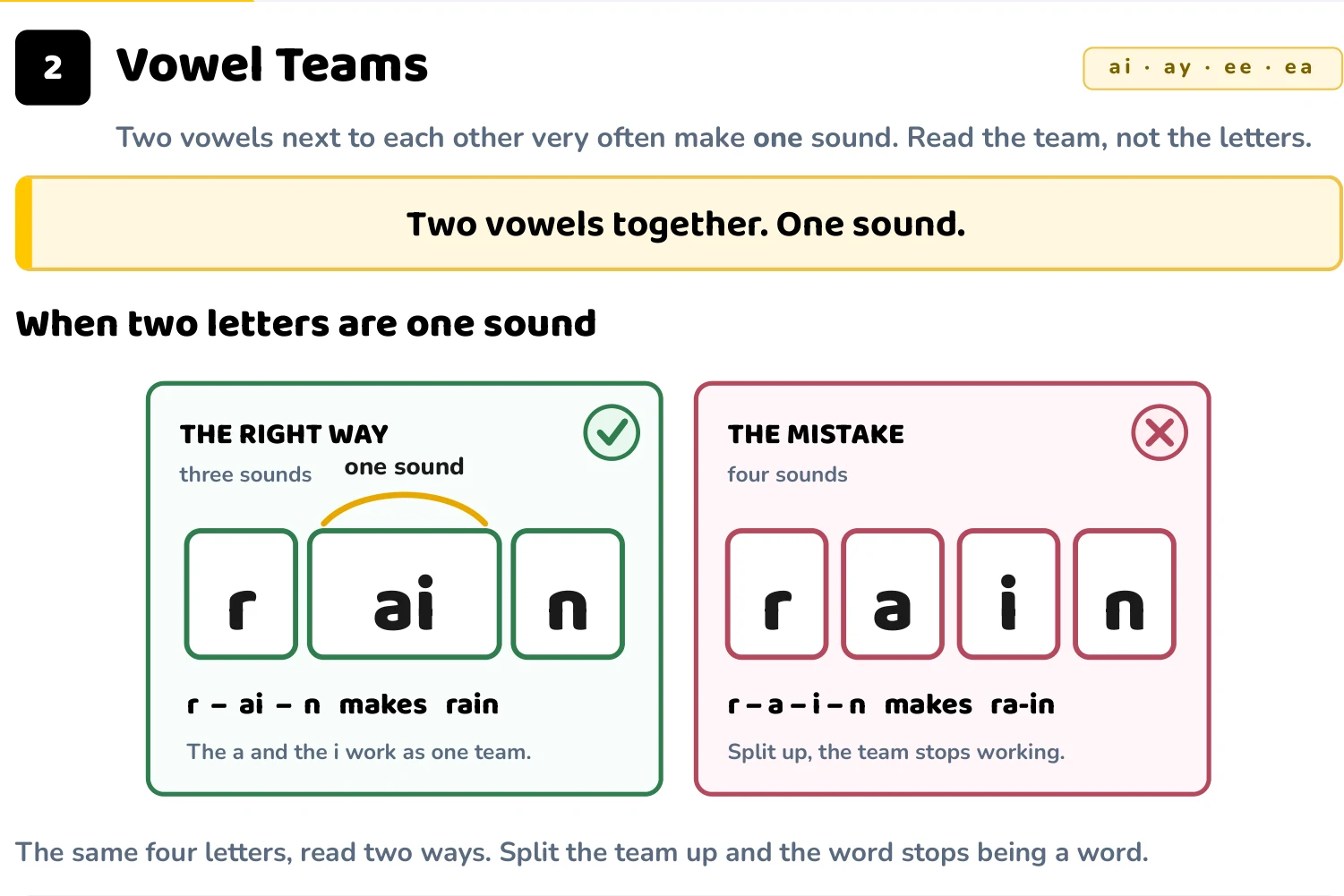
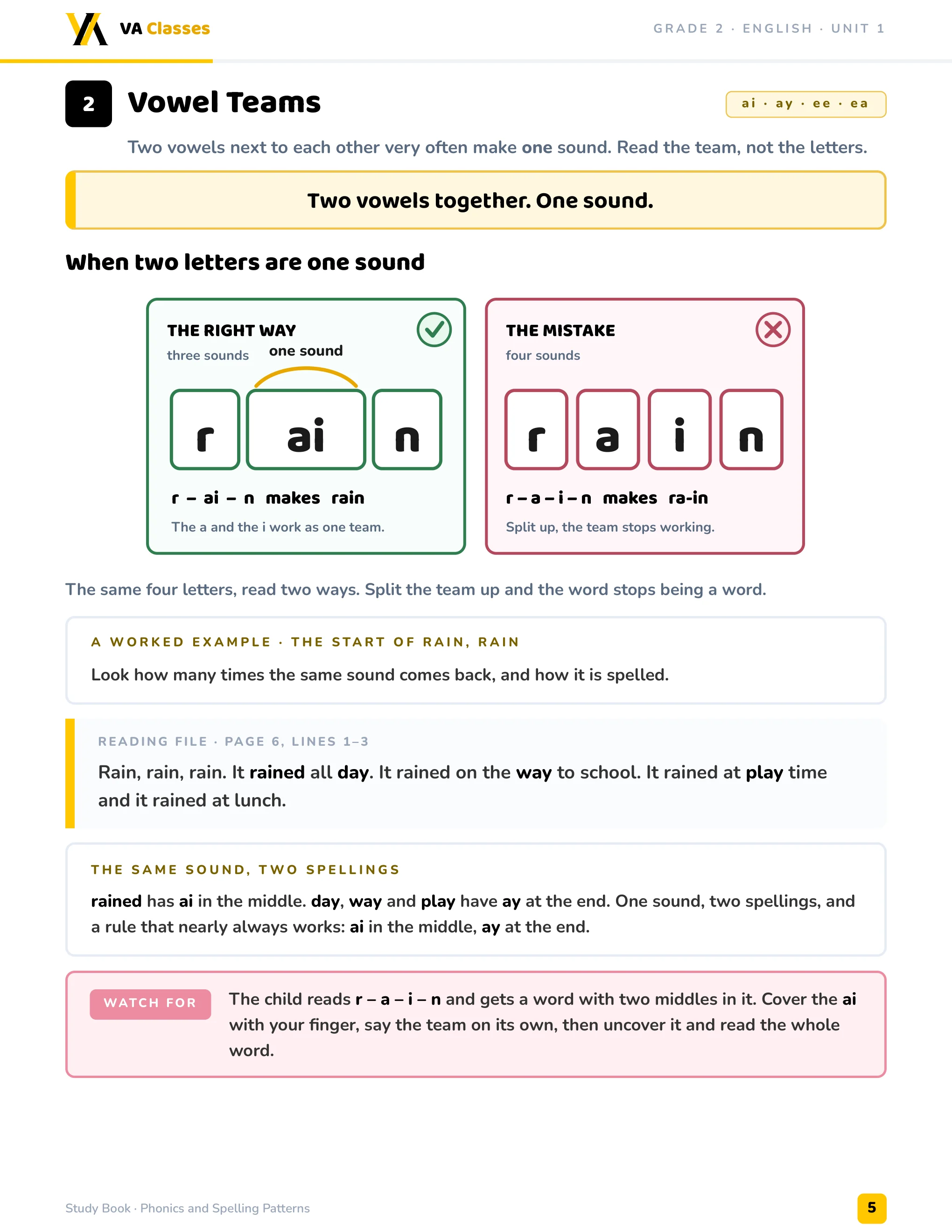
Not a sample, not a mock-up. This is Lesson 2, "Vowel Teams", from Unit 1 of the Grade 2 English pack, taken straight off the file you would download. Every lesson in all 18 courses, English, Math and Science, is built to this shape.

The idea, and the mistake beside it

The idea, and the mistake beside it

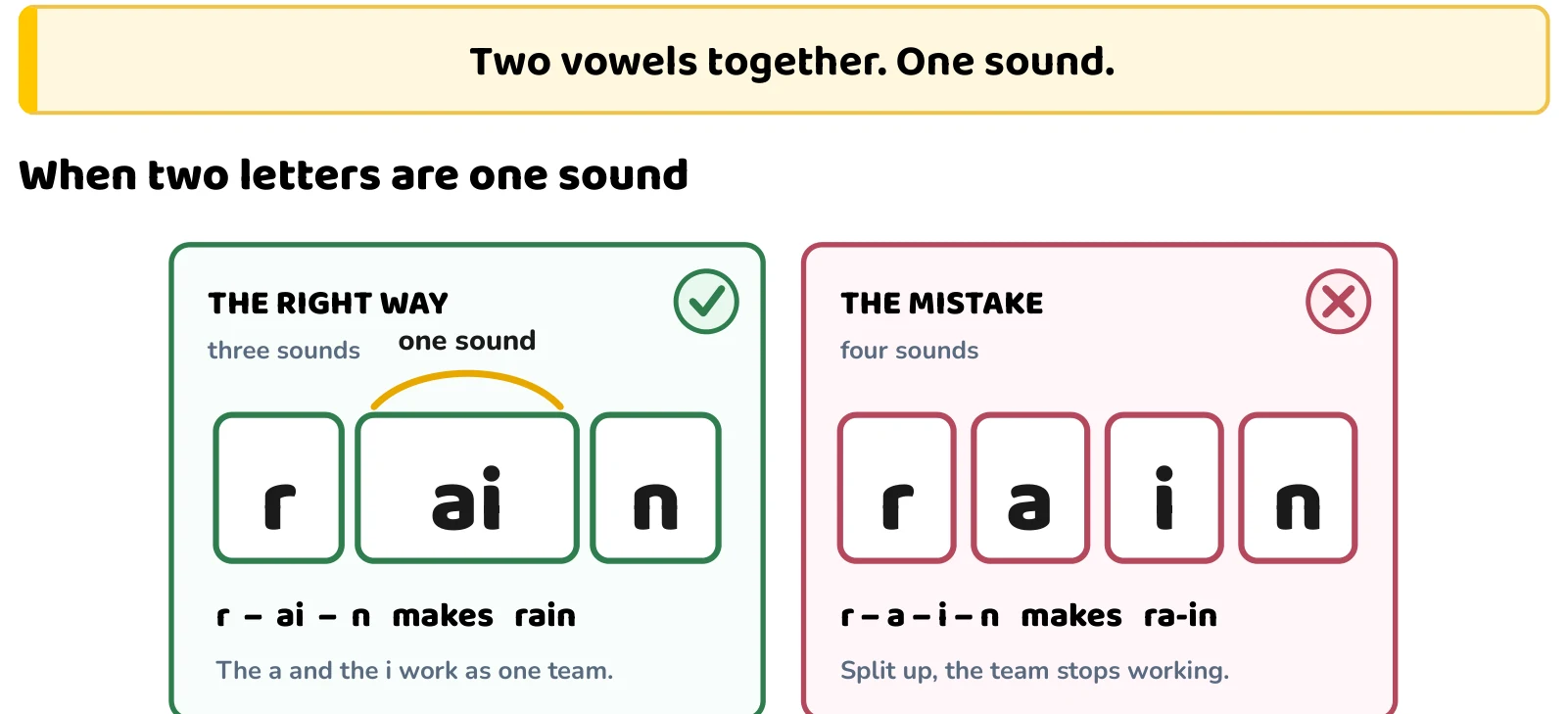
Every lesson shows the wrong way as well as the right way, on the same word, because the wrong way is what your child is about to do. Naming it is what stops it.

The words to say, already written

The words to say, already written

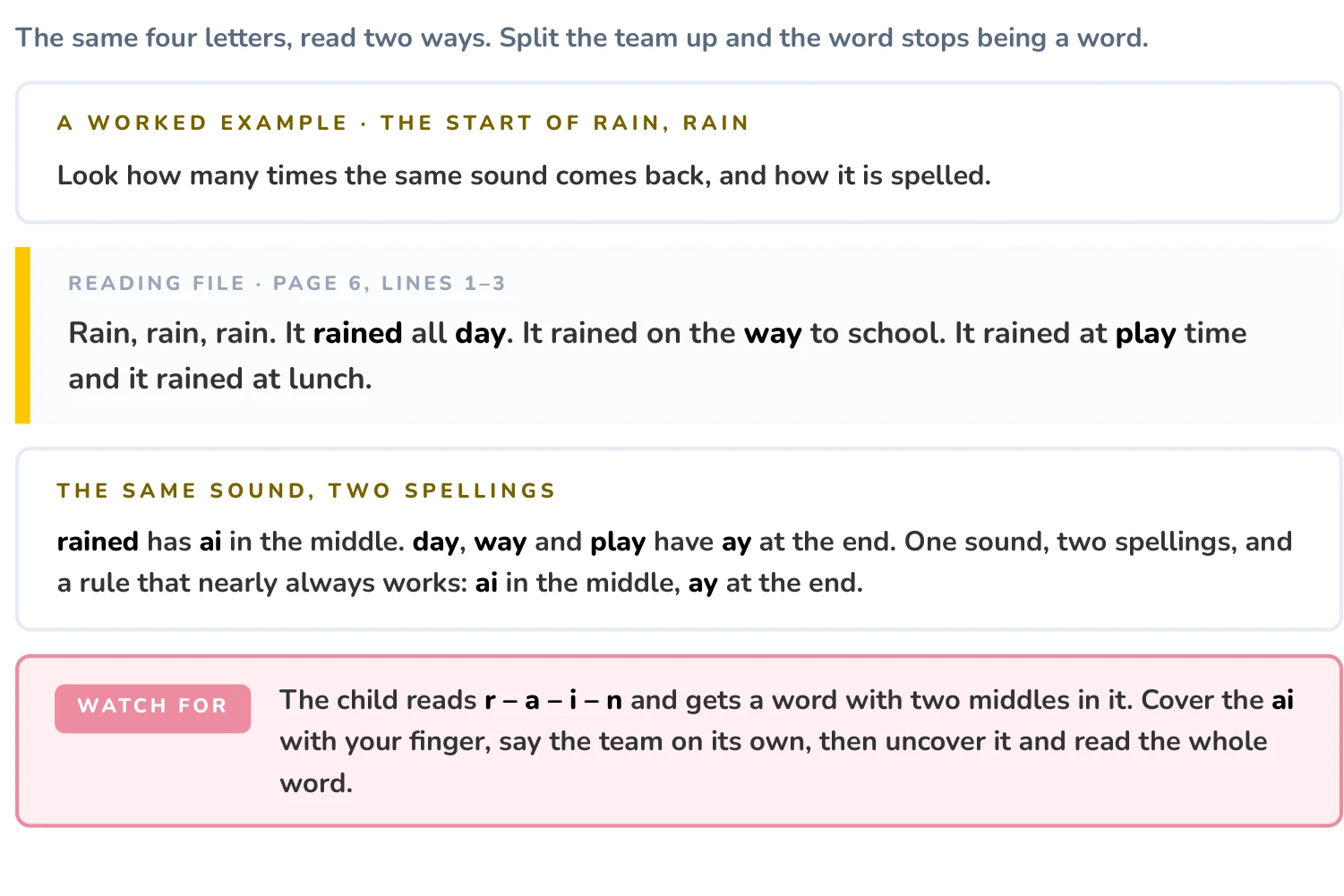
A worked example, the passage quoted with its page and line numbers so you are never hunting for it, and a box that says what to watch for while your child reads.

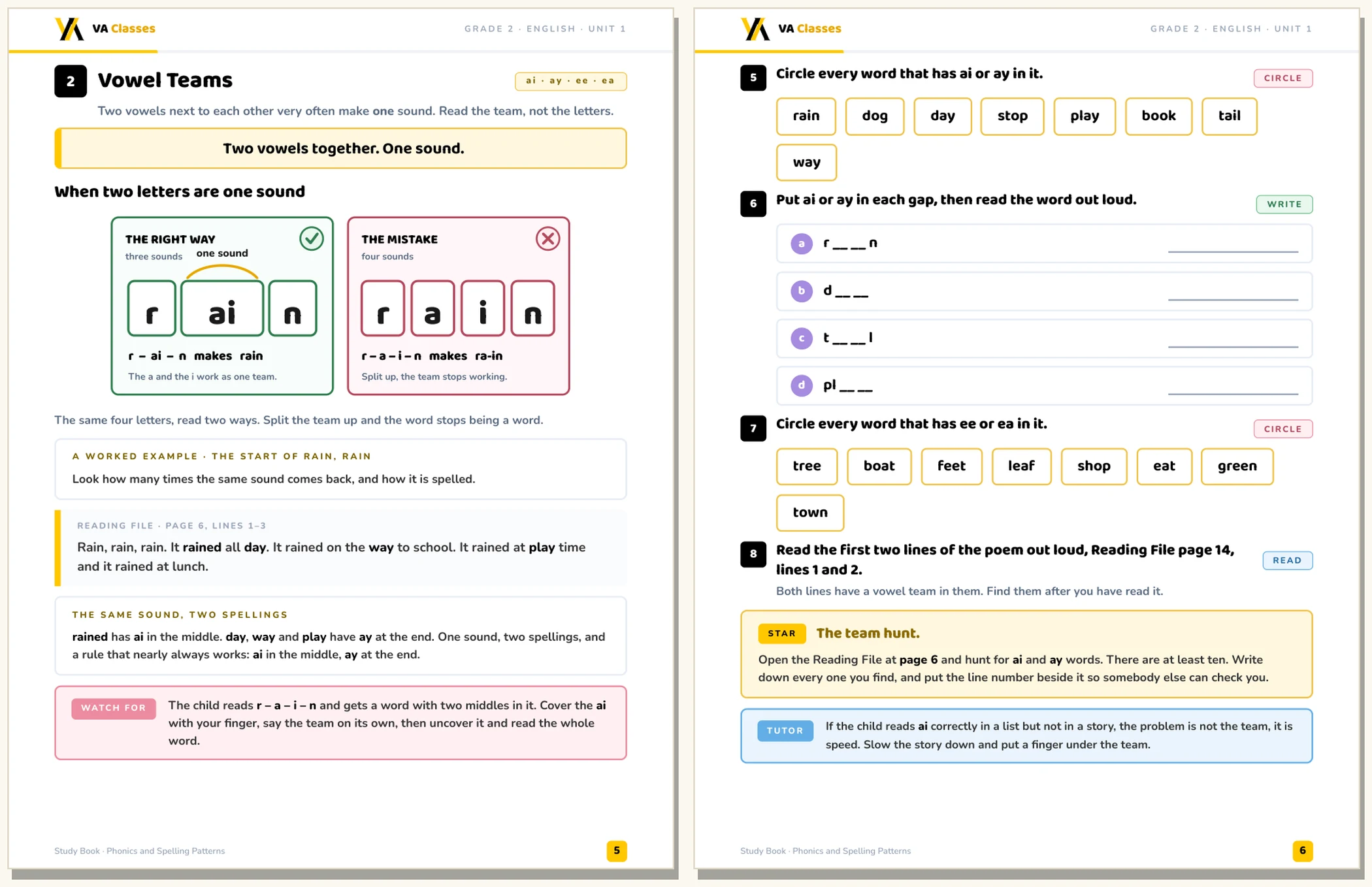
The two pages whole, side by side: the teaching page and the page the child writes on
The same two pages, whole. You read the left one, your child writes on the right one. Open one at full size

Why this is not a pack of worksheets

One skill, followed all the way through the unit.

A worksheet is one page that does not know any other page exists. Here is a single skill out of Grade 2 English, Unit 1: vowel teams, the two letters that make one sound. It is taught, then practised, then played with, then marked, in that order, and the workbook page says on its own face which lesson it belongs to. Watch the word rain in all four. Every unit of all 18 courses, in all three subjects, is built this way.

Swipe each picture sideways to read all of it.

1Taught

Study Book, page 5

The lesson. One idea, the right way and the mistake side by side on the same word, and the sentence the tutor says out loud.

Taught: Study Book, page 5

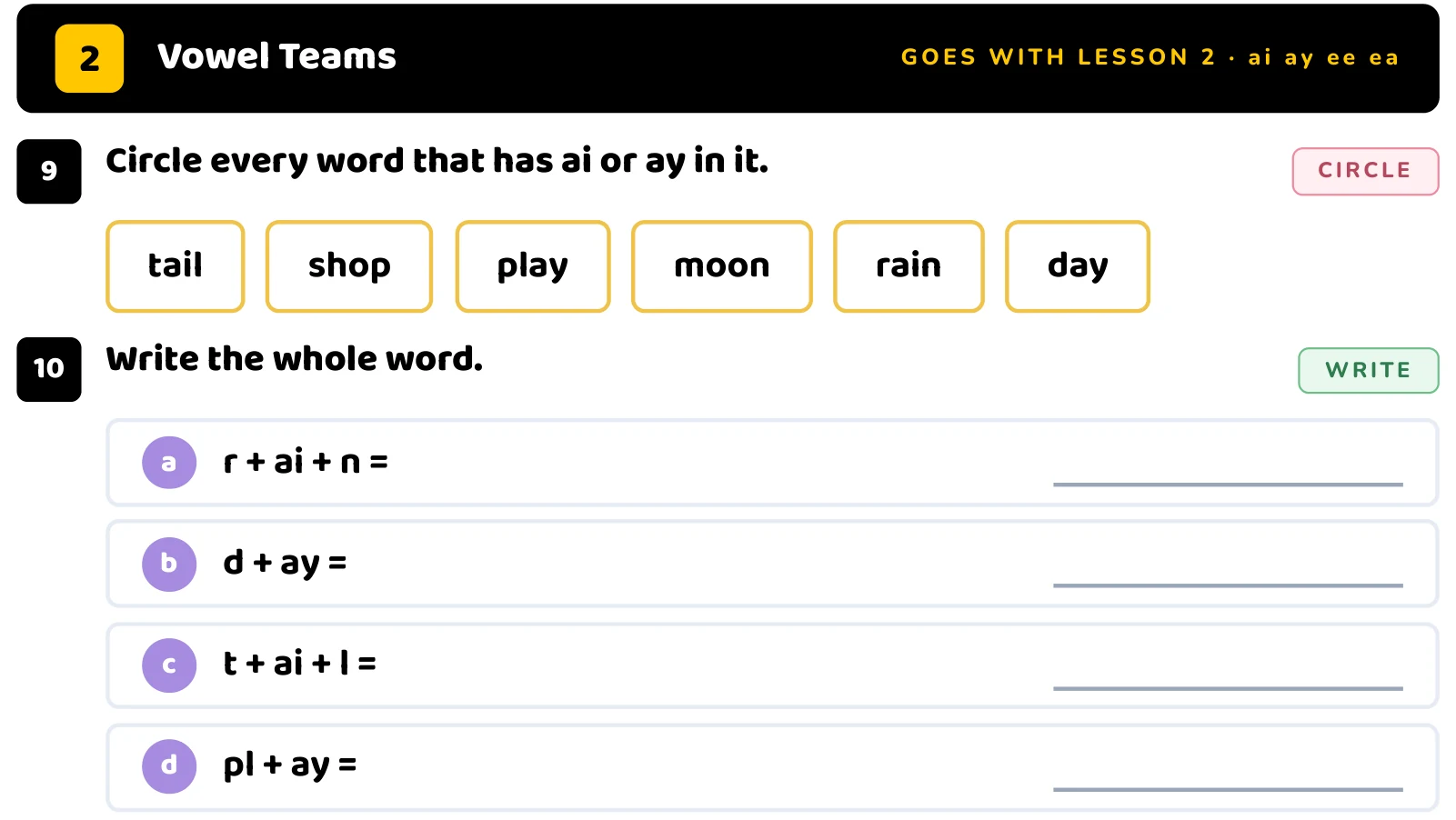
2Practised

Workbook, page 5

The practice, in the order it was taught. The page says GOES WITH LESSON 2 on its own face, so nobody has to guess what comes next.

Practised: Workbook, page 5

3Drilled

Skills Drill, page 12

The repetition, as a game that takes five minutes. The same vowel teams, now hunted in the story the child has already read.

Drilled: Skills Drill, page 12

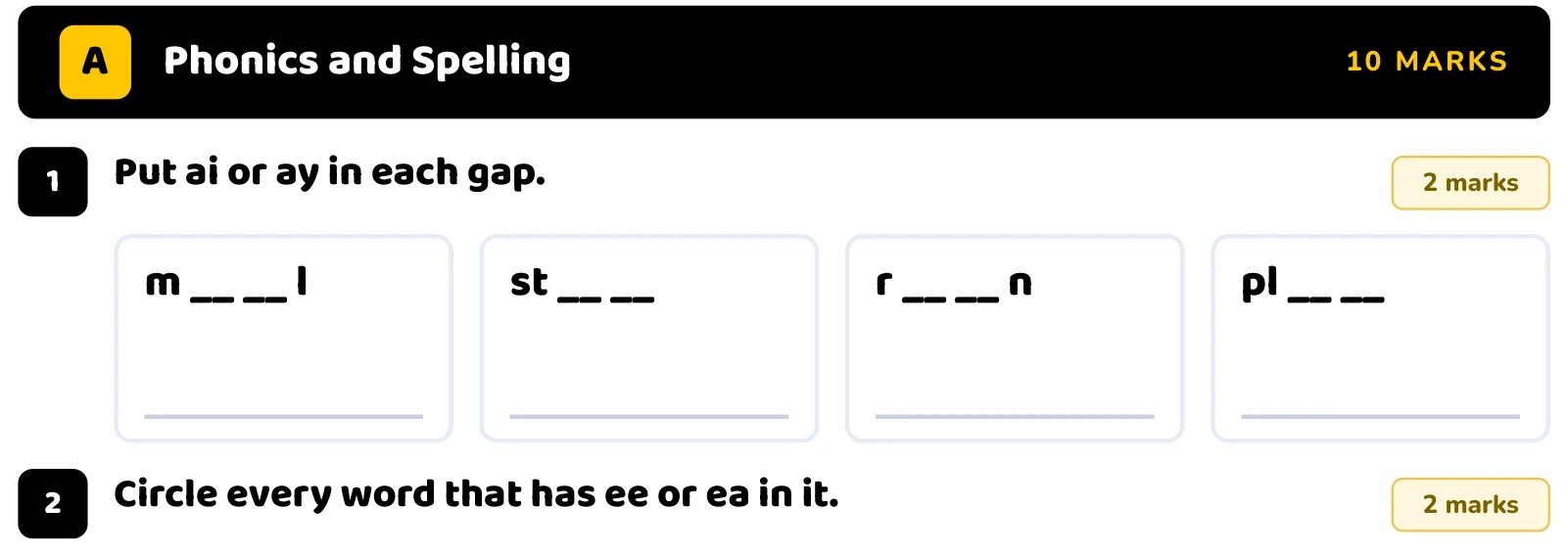
4Tested

Unit 1 Test, page 1

The test. Section A is this skill and nothing else, worth 10 of the 45 marks, and the sheet at the back turns the marks into a level.

Tested: Unit 1 Test, page 1

Four documents, one skill, in the order a tutor teaches it. That order is the thing you are buying.

The year, before you pay for it

Every unit and every lesson is on this page already.

Ten units, roughly one a month. This is the Grade 2 English year; each course below opens the same way, and carries the same plan as a free PDF inside the pack.

Month 1

Phonics and Spelling Patterns9 lessons

Month 2

Reading Fluency9 lessons

Month 3

Comprehension9 lessons

Month 4

Grammar Basics9 lessons

Month 5

Sentence Writing9 lessons

Month 6

Narrative Writing9 lessons

Month 7

Nonfiction Reading9 lessons

Month 8

Vocabulary Building9 lessons

Month 9

Speaking and Presenting9 lessons

Month 10

Review9 lessons

Eighteen courses, ready now

Pick the grade your child is in.

English for grades 1 to 8; math for grades 1 and 2; science for grades 1 to 8. Press a grade to see only that grade.

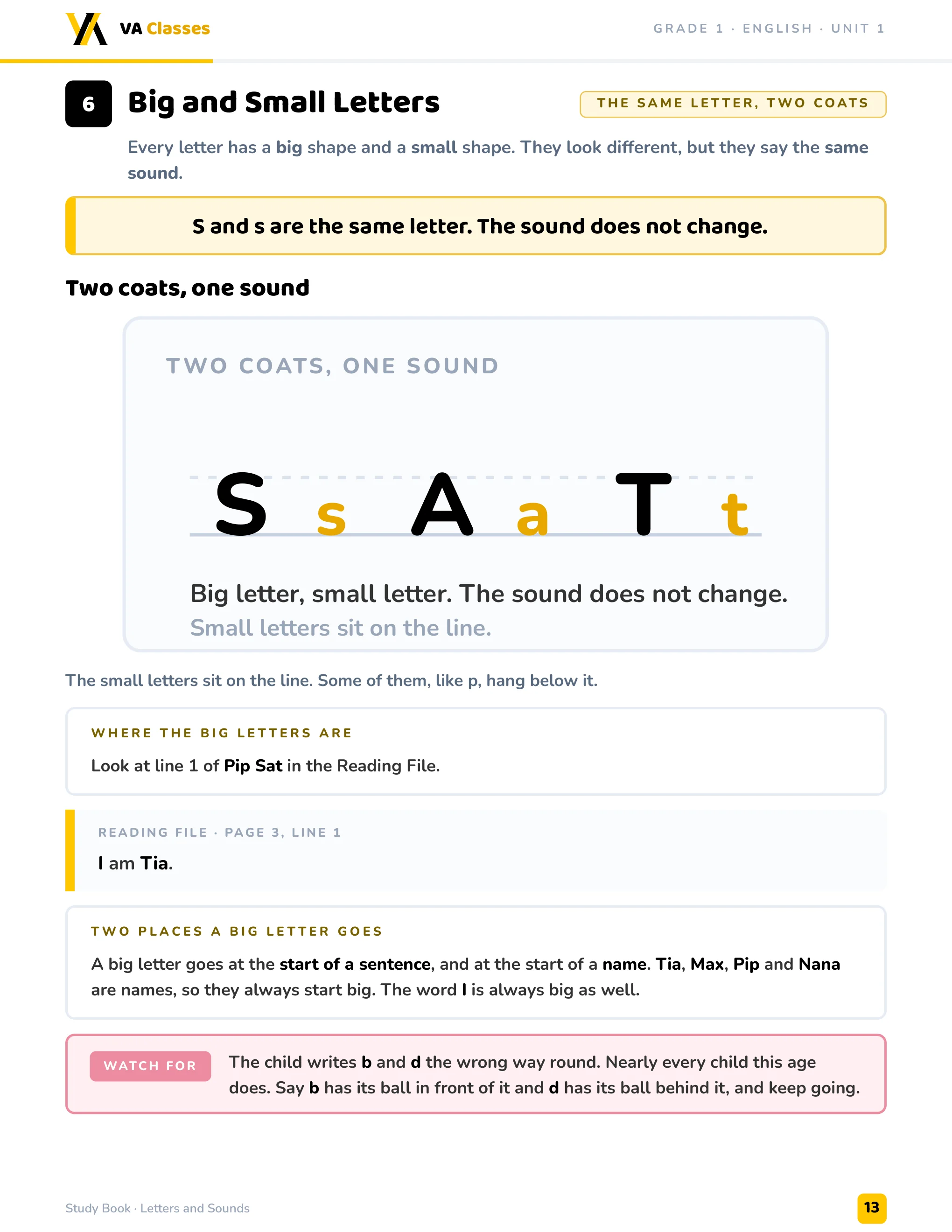
A Study Book page from the Grade 2 English pack
EnglishTen units. A Reading File, Study Book, Workbook, Skills Drill and Unit Test in every one.
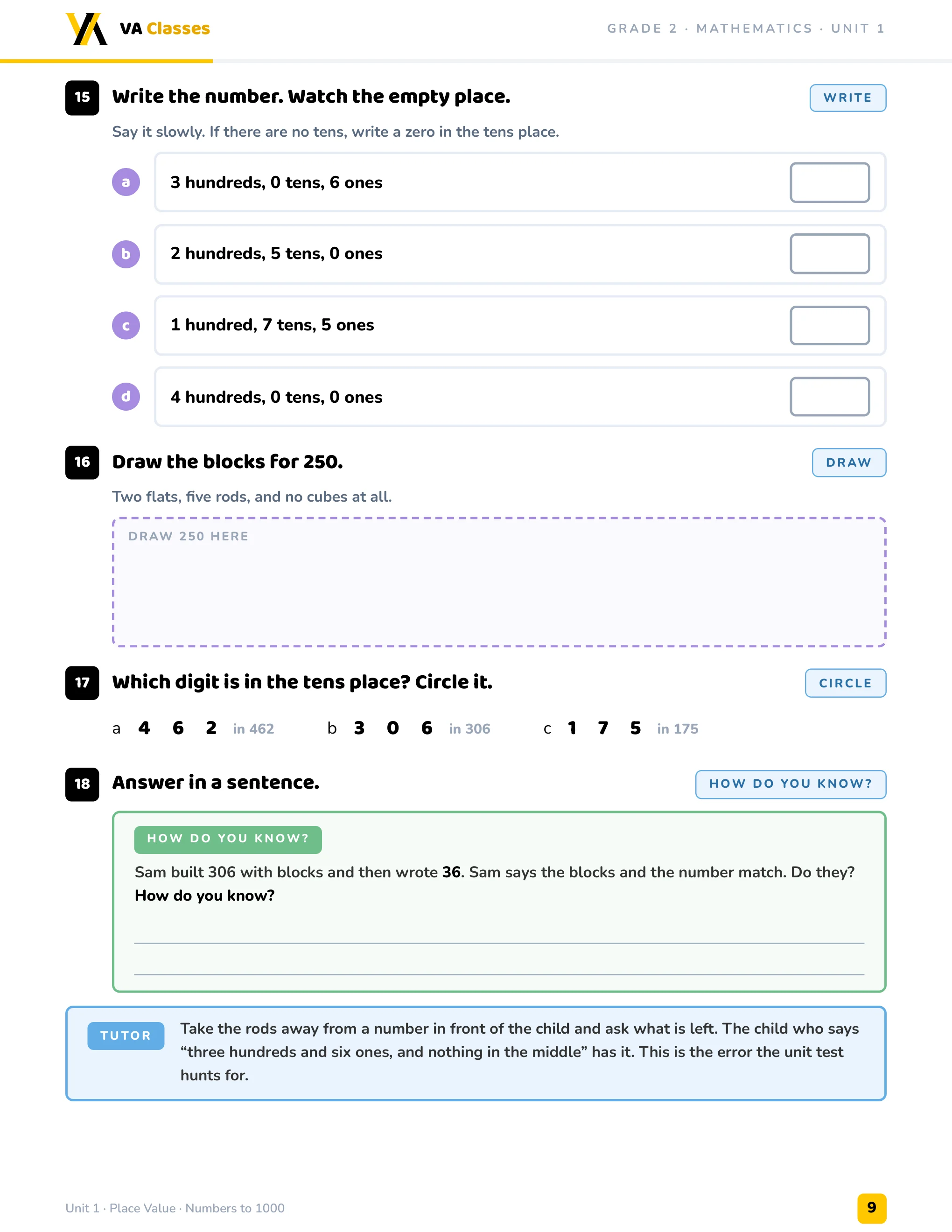
A Study Book page from the Grade 2 Mathematics pack
MathTen units. A Study Book, Workbook, Drill Book and Unit Test in every one.
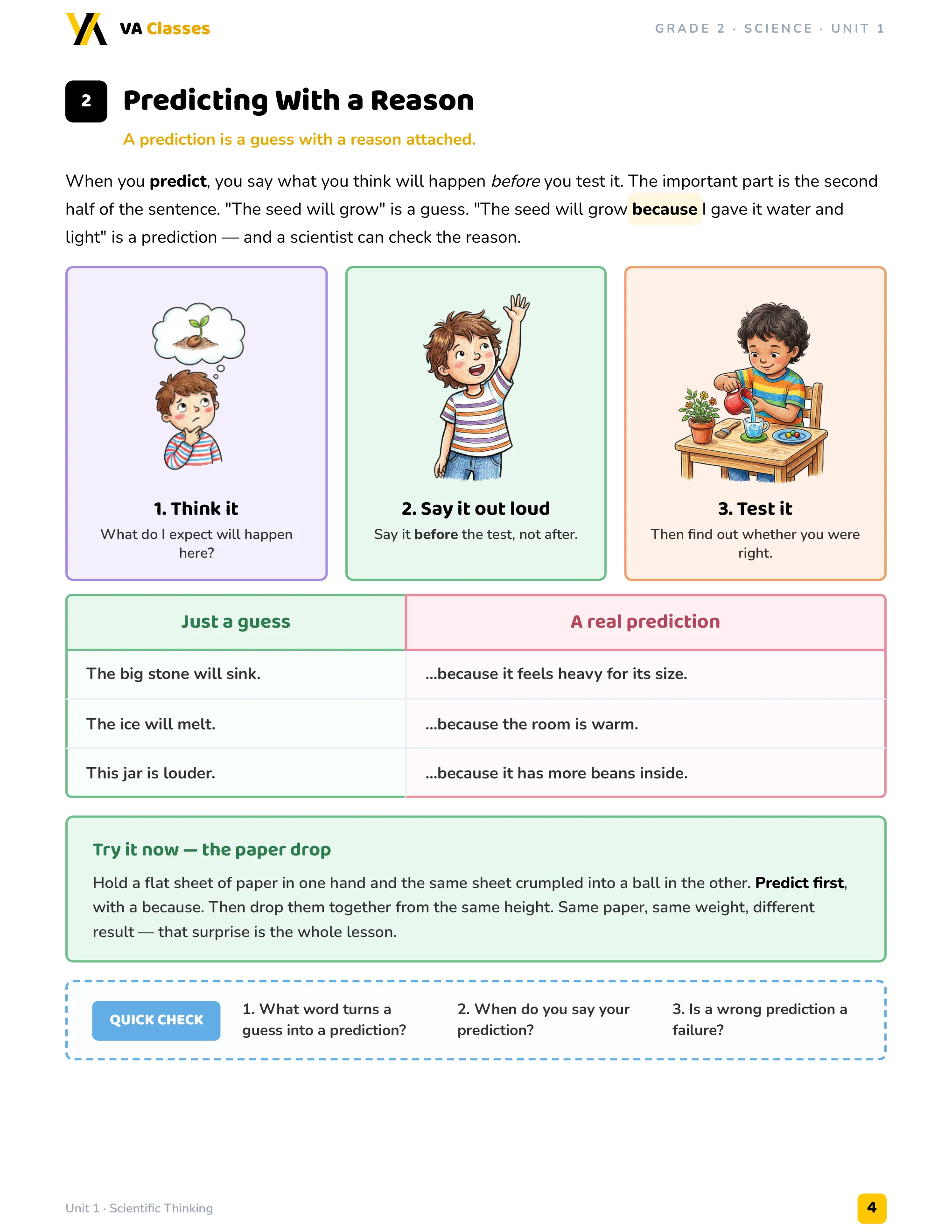
A Study Book page from the Grade 2 Science pack
ScienceSeven units. A Study Book, Workbook, Drill Book and Unit Test in every one.

The Study Book cover of the Grade 1 English pack

Grade 1 · English

Grade 1 English

A full year of Grade 1 English, from single letters to a sentence the child writes alone.

10 units50 documents666 pages80 lessons
  • Letters and their sounds, blending short words, and the sight words that do not follow the rules
  • Digraphs, blends, long vowels and magic e, one pattern at a time
  • Reading a short story and being able to say what happened
  • Naming, doing and describing words, first sentences, and writing about yourself
Annual learning plan, free PDF
Every one of the 80 lessons, by unit
  1. Unit 1: Letters and SoundsLetters Make Sounds, s, a, t, p, i, n, m, d, g, o, c, k, Pushing Sounds Together, Big and Small Letters, Words We Just Know, Reading a Whole Line
  2. Unit 2: Blending Short Wordse and u, r, h, b, f and l, Double Letters, ck at the End, Three Sounds in One Go, Six More Words We Just Know, Reading Two Lines
  3. Unit 3: Sight Words and Reading Aloudj and v, w, y and z, Eight More Words We Just Know, When Somebody Talks, Reading It Again, Reading With Your Voice, How Fast Is Just Right, Reading to Somebody
  4. Unit 4: Reading a Short Storyx and qu, Eight More Words We Just Know, Who Is It About?, Where Does It Happen?, What Happened?, Telling It Back, The Beginning, the Middle and the End, Talking About a Story
  5. Unit 5: Digraphs and Blendssh and ch, th, ng and nk, Blends: st and sp, Blends: bl and cr, One Sound or Two?, Six More Words We Just Know, Longer Words, Reading a Longer Text
  6. Unit 6: Long Vowels and Magic eThe e on the End, a_e: cake and make, i_e: kite and bike, o_e and u_e, Same Letters, Two Words, Six More Words We Just Know, Magic e in a Story, Writing With Magic e
  7. Unit 7: Sentencesai: rain and wait, ee: see and green, A Big Letter at the Front, A Dot at the End, A Finger Space, Six More Words We Just Know, Is It a Sentence?, Writing Two Sentences
  8. Unit 8: Naming, Doing and Describing Wordsigh: light and night, oa: goat and road, Naming Words, Doing Words, Describing Words, Six More Words We Just Know, Three Kinds in One Line, Writing With Describing Words
  9. Unit 9: Telling and Writing About Myselfoo as in book, oo as in moon, ar: car and park, or: fork and short, My Name and My Age, Six More Words We Just Know, Telling Somebody About Me, Writing Four Sentences About Me
  10. Unit 10: Review of the YearThe Whole Year, in Order, Short Sounds Again, Long Vowels Again, Vowel Teams Again, Vowels With an r Beside Them, The Words We Just Know, Reading a Word You Have Never Seen, Getting Ready for the Assessment

CA$60once, and the whole year is yours
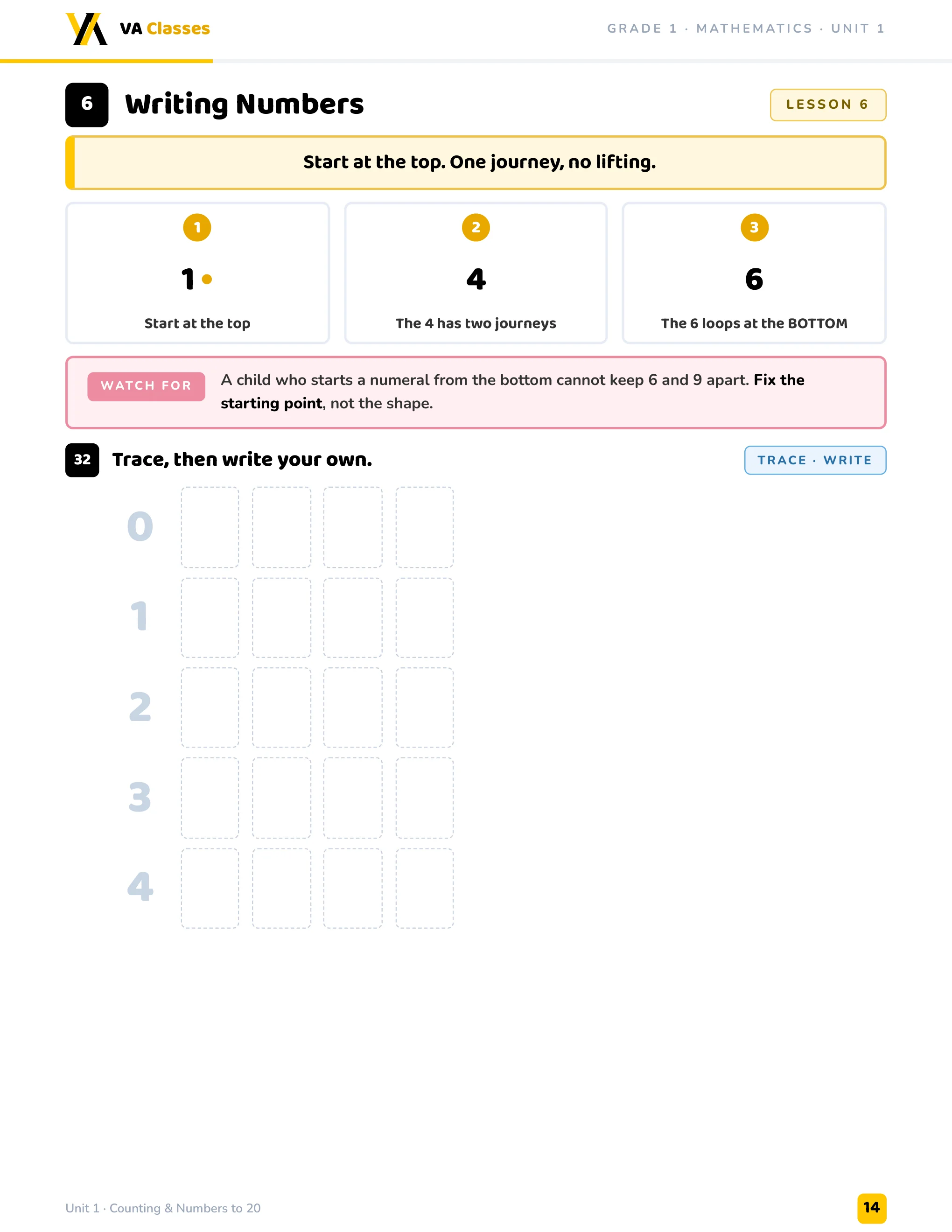
The Study Book cover of the Grade 1 Mathematics pack

Grade 1 · Math

Grade 1 Mathematics

A full year of Grade 1 maths, printed and ready to work through.

10 units40 documents704 pages81 lessons
  • Counting and reading numbers to 100, and what each digit means
  • Adding and subtracting within 20, with the strategies written out rather than assumed
  • Shapes, measurement, time and the calendar
  • A first look at sorting and simple data
Annual learning plan, free PDF
Every one of the 81 lessons, by unit
  1. Unit 1: Counting to 20One number for one thing, Count on from any number, The last number is the answer, Five and some more, Ten and some more, Write every number, Where a number lives, More, less, the same, Line, ring, scatter
  2. Unit 2: Numbers to 100Ten ones make one ten, Count the bundles: 10, 20, 30, 47 is 4 tens and 7 ones, Right one more, down ten more, Count the pairs, A whole hand at a time, Add a bundle from anywhere, The tens decide first, Smallest first
  3. Unit 3: Addition BasicsTwo groups become one, Read it like a story, Start big, count on, Hops forward on the line, Turn it around: 2 + 7 = 7 + 2, The pairs that make ten, Ten and some more, A double is two equal rows, Hear it, show it, write it
  4. Unit 4: Subtraction BasicsCross out. Count what is left, minus takes from · big number first, Say 11, 10, 9. Never say the 12, The bit that sticks out, Nothing goes, and it is still minus, The add already holds the answer, Ten take four. Say it, do not work it out, Two parts and a whole, four sentences, Thirteen balloons, five pop
  5. Unit 5: PatternsThe same little piece, again and again, Ring the core, Patterns you can hear, AB, AAB, ABB, ABC, What comes next?, Find the one that does not fit, Make one of your own, Same pattern, new clothes, Numbers make patterns too
  6. Unit 6: ShapesFour flat shapes, Sides and corners, Turn it, it stays itself, One rule at a time, Solids are held, Faces you can trace, Roll, stack or slide, Two make one, Above, below, between
  7. Unit 7: MeasurementLonger or shorter, Line up the ends, How many cubes long, The same unit, both times, Taller and shorter, The heavy side goes down, Holds more, holds less, Put three in order, The measure hunt
  8. Unit 8: Time and CalendarMorning, afternoon, evening, night, First, next, last, Seven days, said as a loop, Twelve months, then again, Four seasons, four changes, A row is one week, Short hand, long hand, Minute hand on 12, A time for each thing I do
  9. Unit 9: Sharing and DataFair means the same, One for you, one for me, Two equal parts, Equal groups of three, One rule at a time, Count in fives, One picture, one child, One square, one thing, Ask, count, show
  10. Unit 10: ReviewRevisits Units 1 to 9

CA$60once, and the whole year is yours
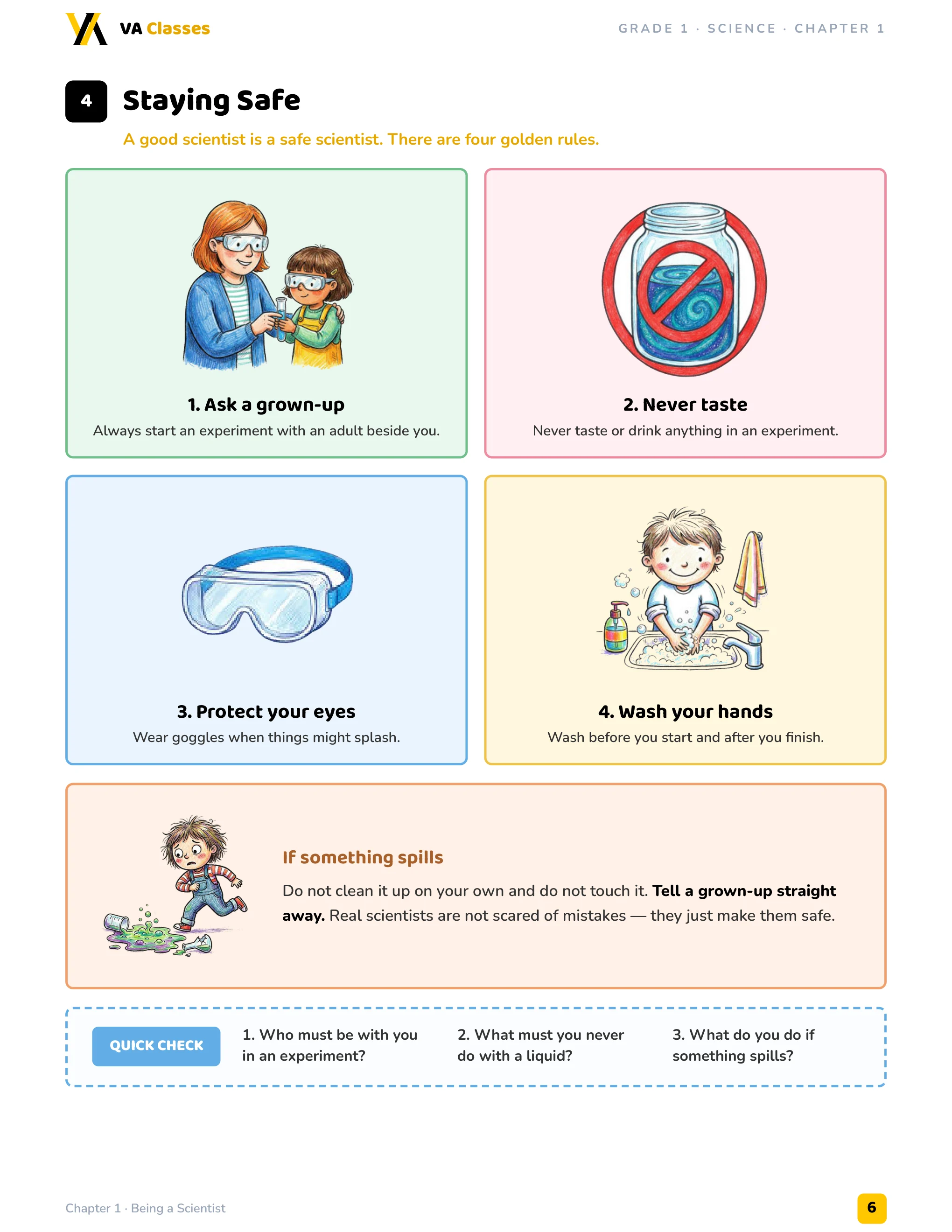
The Study Book cover of the Grade 1 Science pack

Grade 1 · Science

Grade 1 Science

A first year of science: looking carefully, and saying what you noticed.

7 units24 documents120 pages25 lessons
  • Being a scientist: looking, sorting, measuring and recording
  • What living things need, and how they are alike and different
  • Materials, objects and the structures built from them
  • Energy in our lives, and the changes that come with the day and the seasons
Annual learning plan, free PDF
Every one of the 25 lessons, by unit
  1. Unit 1: Being a ScientistWhat is a scientist?, Our five senses, Science tools, Staying safe, Ask, Try, Tell
  2. Unit 2: Needs and Characteristics of Living ThingsWhat is a living thing?, Living or non-living?, The five needs, Parts of a plant, Caring for living things
  3. Unit 3: Materials, Objects and StructuresWhat are things made of?, Sorting by properties, Choosing the right material, Objects and structures, Build it strong
  4. Unit 4: Energy in Our LivesWhat is energy?, Where energy comes from, Energy in our homes, Staying safe with electricity, Saving energy
  5. Unit 5: Daily and Seasonal ChangesDay and night, From morning to night, The four seasons, How we change with the seasons, How plants and animals change
  6. Unit 6: Review and Celebration of LearningReview and Celebration of Learning
  7. Unit 7: Term and Year-End TestsTerm and Year-End Tests

CA$40once, and the whole year is yours

The Study Book cover of the Grade 2 English pack

Grade 2 · English

Grade 2 English

A full year of Grade 2 English: phonics, reading and the first real sentences.

10 units50 documents854 pages90 lessons
  • Phonics and spelling patterns, taught as patterns rather than word lists
  • Reading fluency and comprehension, with the passages included
  • Grammar basics and sentence writing
  • A first narrative, nonfiction reading, and speaking out loud
Annual learning plan, free PDF
Every one of the 90 lessons, by unit
  1. Unit 1: Phonics and Spelling PatternsSounds and Letters, Vowel Teams, More Vowel Teams, Blends at the Front, Two Letters, One Sound, Endings, Words We Just Know, Breaking a Long Word, Spelling What You Hear
  2. Unit 2: Reading FluencyReading Smoothly, Where to Stop, Your Voice Goes Up, Your Voice Gets Bigger, Reading the Talking Bits, Which Word to Lean On, Getting Faster Without Rushing, Reading It Again, Reading to Somebody
  3. Unit 3: ComprehensionWhat Happened, in Order, Who, Where, When, Saying It Back, Asking While You Read, Working It Out, Which Words Told You, What the Picture Tells You, What Might Happen Next, Telling Somebody
  4. Unit 4: Grammar BasicsWhat a Sentence Is, Capitals, Full Stops, Question Marks, Naming Words, Doing Words, Describing Words, Is or Are, Was or Were, Checking Your Own
  5. Unit 5: Sentence WritingA Sentence That Works, Adding Who and What Kind, Adding Where, Adding When, Adding How, Joining With And, Joining With But and So, Sentences of Different Lengths, Four Sentences That Belong Together
  6. Unit 6: Narrative WritingWhat a Story Needs, The Beginning, The Problem, What They Tried, The Ending, Talking in Stories, Describing Words, Planning First, Reading It Out
  7. Unit 7: Nonfiction ReadingTrue Books Are Different, Headings, Labels and Diagrams, Captions, Fact Boxes, Finding One Fact Fast, Steps in Order, True or Not True, Telling Somebody Three Facts
  8. Unit 8: Vocabulary BuildingUsing the Sentence Around It, Looking at the Picture, Words That Mean Nearly the Same, Words That Mean the Opposite, Compound Words, Word Families, One Word, Two Meanings, Choosing a Better Word, Keeping Your Own Words
  9. Unit 9: Speaking and PresentingSpeaking in Whole Sentences, Loud Enough, Slow Enough, Looking at People, One Thing at a Time, Starting Well, Showing While You Talk, Listening Properly, Asking a Good Question, Saying Something Kind and Useful
  10. Unit 10: ReviewSounds and Spelling, Reading Aloud, Understanding, Sentences and Grammar, Writing a Story, True Books, Words, Speaking, Being a Reader and a Writer

CA$60once, and the whole year is yours
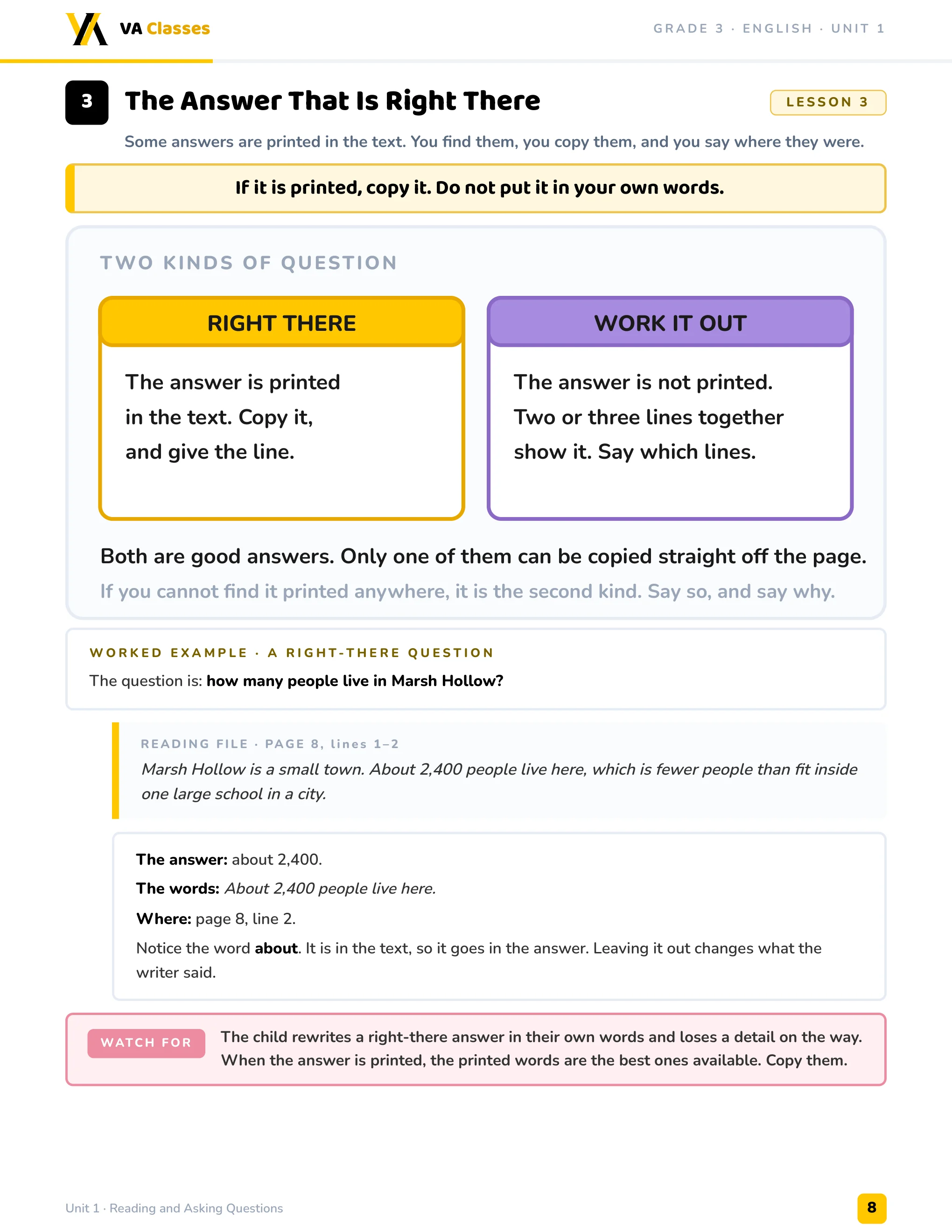
The Study Book cover of the Grade 2 Mathematics pack

Grade 2 · Math

Grade 2 Mathematics

A full year of Grade 2 maths, from place value to the first fractions.

10 units40 documents736 pages90 lessons
  • Place value to 1000, and why regrouping works
  • Addition and subtraction strategies, one strategy at a time
  • Early multiplication as equal groups, and halves, thirds and quarters
  • Money, measurement, time and reading a simple graph
Annual learning plan, free PDF
Every one of the 90 lessons, by unit
  1. Unit 1: Place ValueThe 4 in 47 means four tens, Ten tens make one hundred, Three digits, three jobs, Say the hundreds first, Expanded form shows the value, One place on the line, Compare the hundreds first, Five or more rounds up, The step does not change
  2. Unit 2: Addition StrategiesAdd whole hundreds and whole tens, Jump to the next ten first, Ones under ones, tens under tens, Ten ones become one ten, Ten tens become one hundred, Two carries in one sum, The equal sign balances, Round first, then check, Two steps, said out loud
  3. Unit 3: Subtraction StrategiesTake the hundreds, leave the rest, Hop back in easy steps, Ones under ones, tens under tens, Break a ten into ten ones, Break a hundred into ten tens, A zero sends you next door twice, Three numbers, four sentences, Estimate first, then check, Two steps, say the first one
  4. Unit 4: Early MultiplicationFour equal groups of three, The same number, added again, Four groups of three, Three rows of five, Turn it, same answer, The two times table, The ten times table, The five times table, Twelve shared into three
  5. Unit 5: FractionsEqual parts, or it is not a fraction, One half of a shape and of a group, One quarter is two halves halved, One third is three equal parts, The bottom names, the top counts, One third of twelve is four, Three quarters is three of the four, The wall shows which is bigger, Half an hour, half a set
  6. Unit 6: PatternsOne little piece, again and again, Each step bigger by the same amount, Say the rule in words, Continue it, and fill the gaps, Shrinking takes the same amount away, Stripes down the hundred chart, In and out, with one rule, Odd and even, who is left over?, Steps in order make a route
  7. Unit 7: Shapes and GeometryName it by counting, One rule at a time, A cuboid is not a cube, Faces, edges, vertices, Two make one, The fold that works, Slide, flip, turn, Column, then row, Chosen for the job
  8. Unit 8: Measurement and TimeMeasuring starts at the 0, Estimate, measure, compare, Centimetres or metres, Grams and kilograms, Millilitres and litres, Half past and the quarters, Minutes counted in fives, Days, weeks and months, The right tool, the right unit
  9. Unit 9: Money and DataThe bigger coin is not the bigger amount, One kind of coin, one skip count, Biggest coin first, then count on, More than one way to make 65c, The dot is a wall, Four upright, the fifth across, Read the key before the pictures, The scale steps in 2s, Impossible, unlikely, likely, certain
  10. Unit 10: ReviewUnit 1 · 462 is 4 hundreds, 6 tens and 2 ones, Unit 2 · Ten ones become one ten, Unit 3 · Break a ten to get more ones, Unit 4 · 4 groups of 3, and 3 rows of 5, Unit 5 · Equal parts, named and counted, Unit 6 · The rule is add 3 each time, Unit 7 · Count faces, edges and vertices, Unit 8 · Start at zero; read the whole face, Unit 9 · Big coins first; a graph is counting you can see

CA$60once, and the whole year is yours
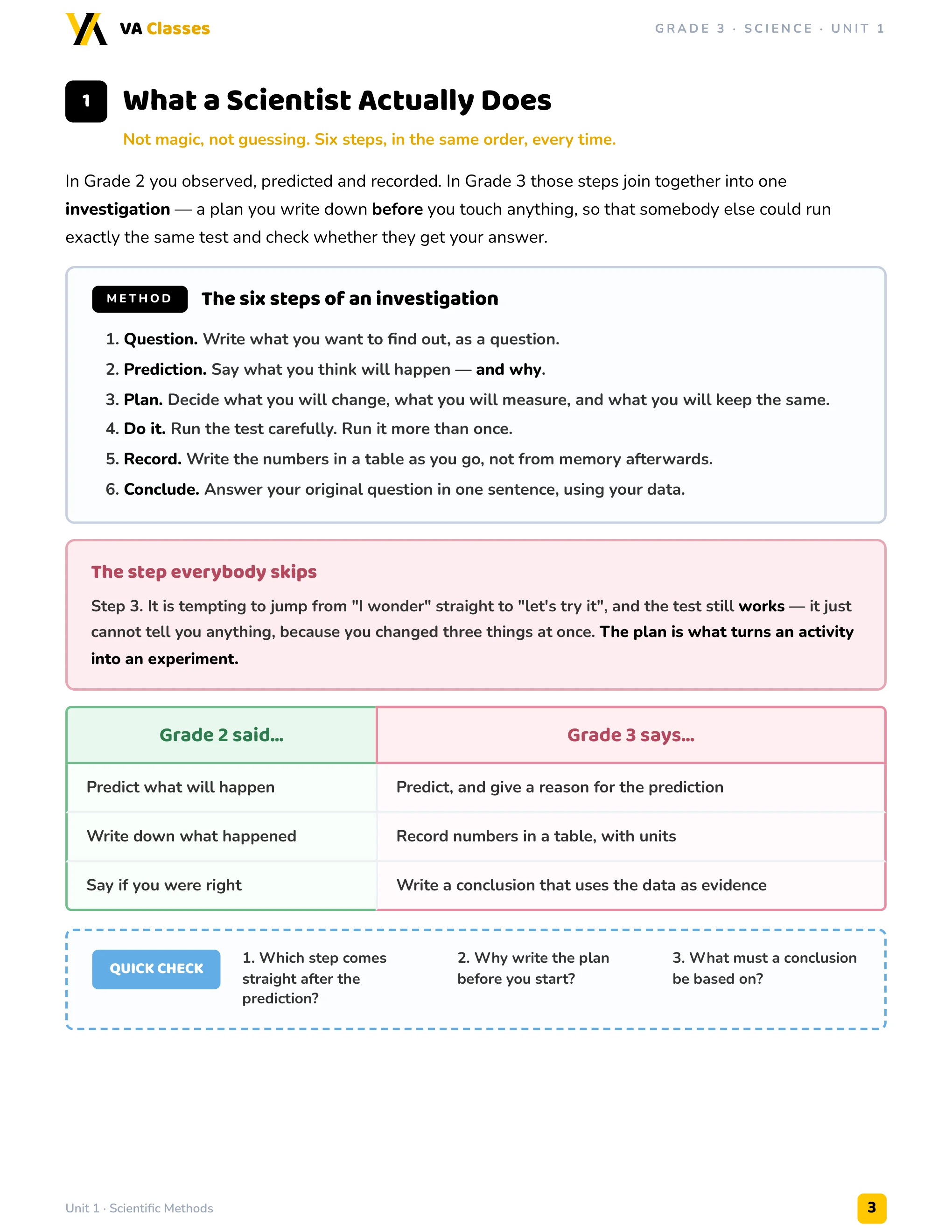
The Study Book cover of the Grade 2 Science pack

Grade 2 · Science

Grade 2 Science

A full year of Grade 2 science: animals, materials, machines and the air and water around us.

7 units27 documents138 pages25 lessons
  • Scientific thinking: a question, a test, and what the result actually showed
  • Growth and changes in animals, and the life cycles behind them
  • Properties of liquids and solids, and what makes them behave differently
  • Simple machines and movement, and air and water in the environment
Annual learning plan, free PDF
Every one of the 25 lessons, by unit
  1. Unit 1: Scientific ThinkingObserving closely, Predicting with a reason, Recording what happened, Comparing and measuring, A fair test
  2. Unit 2: Growth and Changes in AnimalsWhat animals are covered in, How animals move, Animals that change shape, Animals that just grow bigger, Staying alive, and our part in it
  3. Unit 3: Properties of Liquids and SolidsSolid or liquid?, Water can be three things, Float or sink, Soaks up or keeps out, Mixing things together
  4. Unit 4: Simple Machines and MovementPushes and pulls, Wheels make it easy, Levers, Ramps and pulleys, Machines all around me
  5. Unit 5: Air and Water in the EnvironmentAir is really there, What air does for us, Where water lives, When air and water get dirty, What I can actually do
  6. Unit 6: Review and Annual AssessmentReview and Annual Assessment
  7. Unit 7: Term and Year-End TestsTerm and Year-End Tests

CA$40once, and the whole year is yours

The Study Book cover of the Grade 3 English pack

Grade 3 · English

Grade 3 English

A full year of Grade 3 English: paragraphs, word parts, and reading a story that runs for pages.

10 units50 documents840 pages80 lessons
  • Reading closely and asking questions of a text, and finding facts to write from
  • Sentences and punctuation, and word parts that unlock a word nobody taught
  • Writing a paragraph that holds together, and telling a story with a beginning and an end
  • Poems and the sounds of words, a longer story read across several sittings, and speaking to be understood
Annual learning plan, free PDF
Every one of the 80 lessons, by unit
  1. Unit 1: Reading and Asking QuestionsBefore You Read, Asking Questions, The Answer Right There, The Answer You Work Out, Evidence, Not a Story, Pictures and Maps, Putting It Together
  2. Unit 2: Sentences and PunctuationWhat Makes a Sentence, The Four Kinds, The Three End Marks, Capital Letters, Commas in a List, Joining Words, Fixing a Run-On, Choosing the Shape
  3. Unit 3: Word Parts and Word MeaningA Long Word Is a Train, Four Prefixes, Two More Prefixes, Suffixes That Describe, Suffixes That Compare, The Base Word Underneath, Working It Out, Using a Dictionary
  4. Unit 4: Writing a ParagraphWhat a Paragraph Is, The Topic Sentence, Three Details That Belong, Staying on One Idea, Putting Them in Order, The Closing Line, Joining Words, Writing One Good Paragraph
  5. Unit 5: Telling a StoryThe Shape of a Story, A Character Who Wants, Show It, Do Not Tell It, The Opening, The Build-Up, The Climax, The Ending, Writing the Whole Thing
  6. Unit 6: Writing to Inform and Finding FactsWhat Information Is For, Finding the Fact, In Your Own Words, Naming Where It Came From, When Sources Disagree, Is It Worth Trusting?, The Informing Paragraph, Writing a Short Report
  7. Unit 7: Poems and the Sounds of WordsWhat a Poem Is For, The Beat, Rhyme, A Line That Comes Back, The Sounds of Words, Similes, When There Is No Rhyme, Writing and Saying Your Own
  8. Unit 8: Reading a Longer StoryCarrying It a Week, Character, Setting, The Problem, Predict, Then Check, Evidence Across Chapters, What Changed, Writing Chapter Five
  9. Unit 9: Speaking Listening and MediaTalking Is Not Writing, The Shape of Two Minutes, Saying It Out Loud, Listening Is Saying It Back, Asking a Better Question, Who Made It, and What Do They Want?, What Is Left Out, Your Two Minutes
  10. Unit 10: Review of the YearThe Six Forms, Finding It, and Proving It, Sentences and Punctuation, Working Out a Word, Paragraph and Report, Want, Problem, Change, How Do You Know?, Sitting the Paper

CA$60once, and the whole year is yours
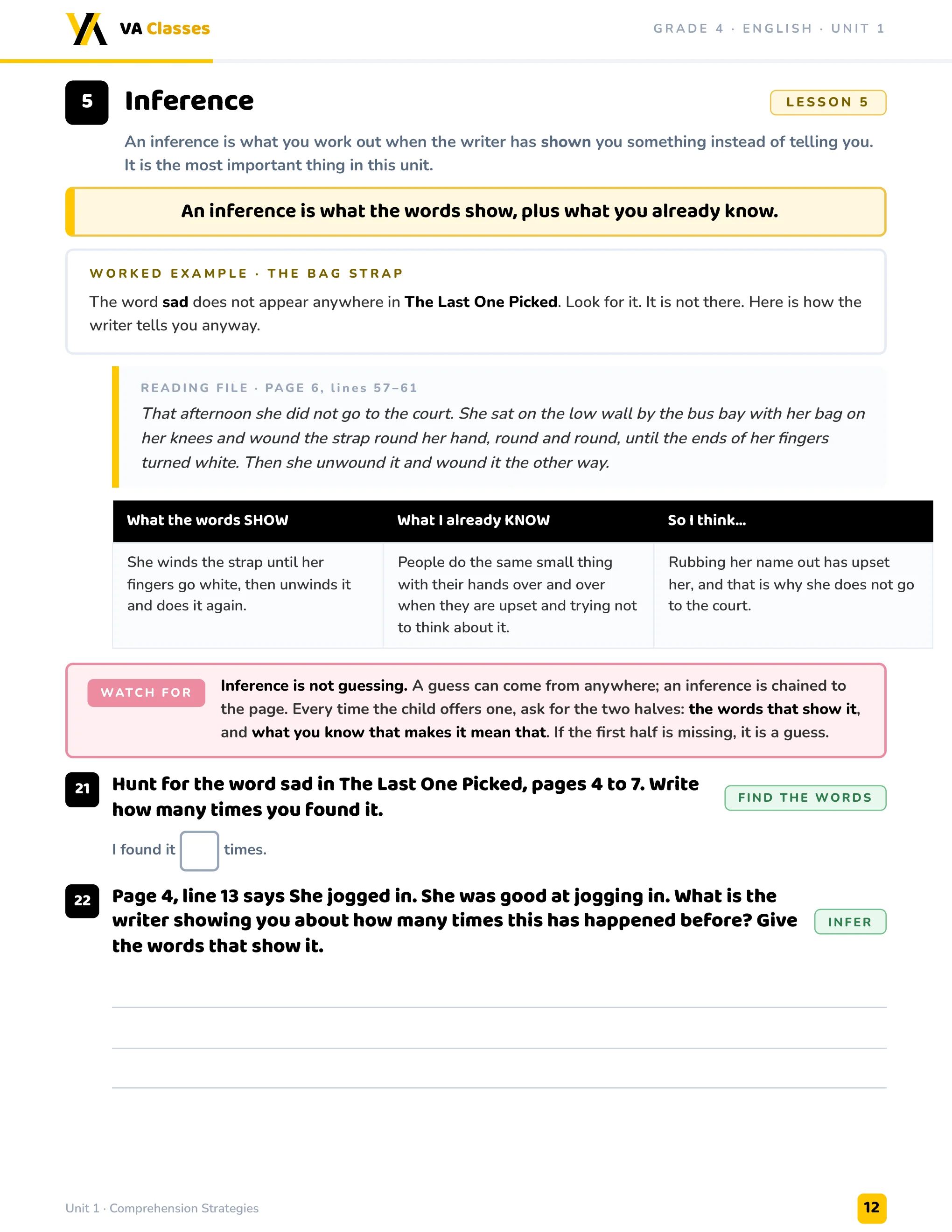
The Study Book cover of the Grade 3 Science pack

Grade 3 · Science

Grade 3 Science

A full year of Grade 3 science: plants, forces, structures and soil.

7 units27 documents179 pages25 lessons
  • Scientific methods: a fair test, and why only one thing changes
  • Growth and changes in plants, from seed to seed
  • Forces causing movement, and strong and stable structures
  • Soils in the environment, and what depends on them
Annual learning plan, free PDF
Every one of the 25 lessons, by unit
  1. Unit 1: Scientific MethodsWhat a scientist actually does, Asking a testable question, Variables and the one-thing rule, Measuring and recording, Reading your results
  2. Unit 2: Growth and Changes in PlantsThe parts of a plant, What plants need to grow, How plants make their own food, The life cycle of a flowering plant, Seed dispersal and plants we use
  3. Unit 3: Forces Causing MovementWhat a force does, Gravity, Friction, Forces without touching, Resistance and balance
  4. Unit 4: Strong and Stable StructuresWhat a structure has to do, Strong shapes, Stability, Choosing materials, Making weak things strong
  5. Unit 5: Soils in the EnvironmentWhat soil is made of, Types of soil, What lives in soil, Why soil matters, Looking after soil
  6. Unit 6: Review and Annual AssessmentReview and Annual Assessment
  7. Unit 7: Term and Year-End TestsTerm and Year-End Tests

CA$40once, and the whole year is yours
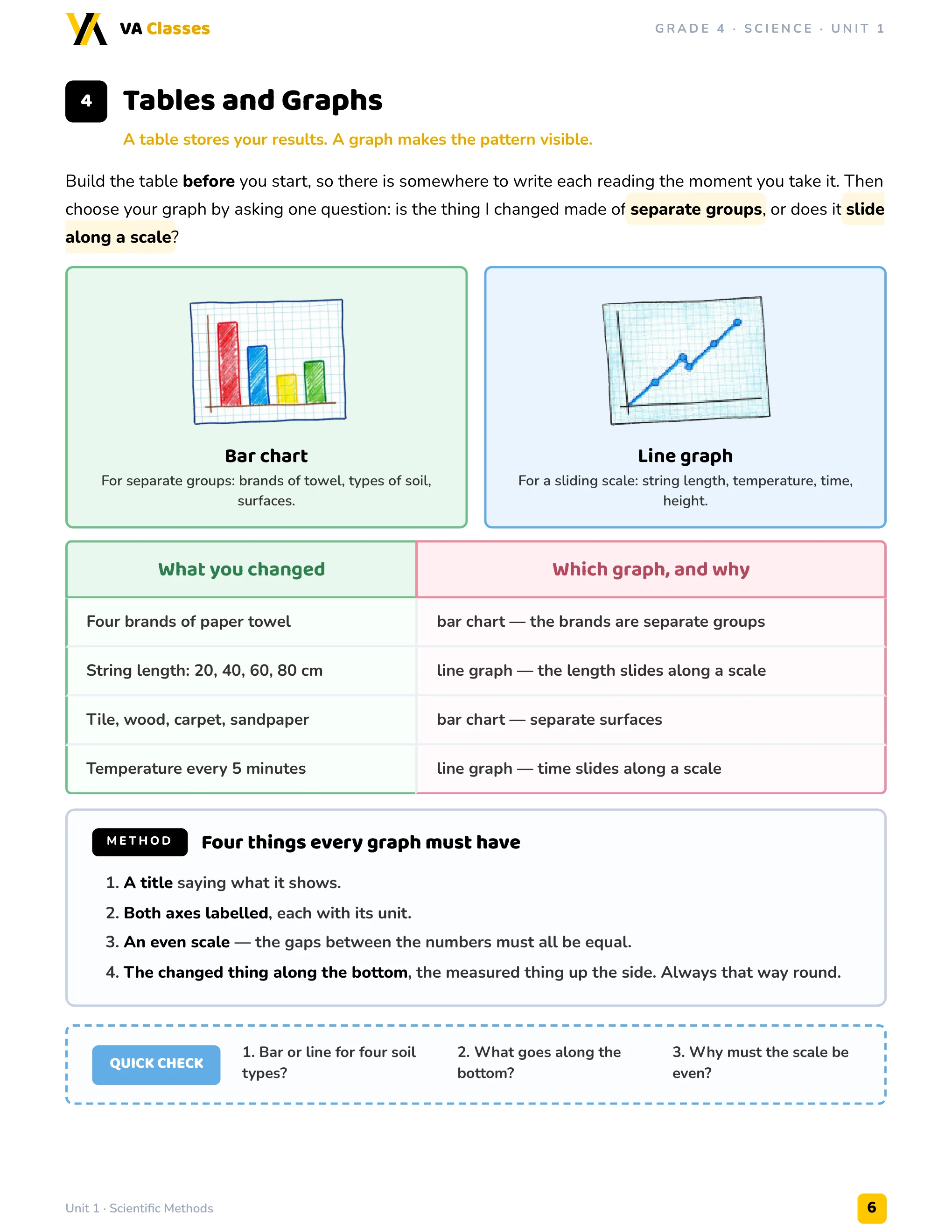
The Study Book cover of the Grade 4 English pack

Grade 4 · English

Grade 4 English

A full year of Grade 4 English, with every reading passage included.

10 units50 documents985 pages90 lessons
  • Comprehension strategies, practised on texts that are printed in the pack
  • Grammar, sentence types, vocabulary and word study
  • Multi-paragraph writing, narrative writing, and a report with research
  • Poetry, a novel study, and presenting to a room
Annual learning plan, free PDF
Every one of the 90 lessons, by unit
  1. Unit 1: Comprehension StrategiesWhat Good Readers Do, Predicting from Evidence, Asking Questions, Making Pictures, Inference, Making Connections, Summarising, Reading Non-Fiction, All Five Together
  2. Unit 2: Grammar and Sentence TypesWhat Makes a Sentence, The Four Sentence Types, Simple, Compound, Complex, The Four Word Jobs, Tenses That Stay Put, Subject and Verb Agree, Marks That Change Meaning, Variety on Purpose, Editing Your Own Writing
  3. Unit 3: Vocabulary and Word StudyWords in Context, The Four Kinds of Clue, Prefixes, Suffixes, Roots, Shades of Meaning, Two Words, One Sound, Using a Dictionary, Your Own Word Bank
  4. Unit 4: Multi-Paragraph WritingWhat a Paragraph Is, The Topic Sentence, Supporting Sentences, The Closing Sentence, Planning Before Writing, Linking Paragraphs, Openings That Work, Endings That Land, Revising, Not Correcting
  5. Unit 5: Narrative WritingWhat Makes a Story, Characters Who Feel Real, Setting That Does a Job, Planning a Plot, Openings That Hook, Writing Dialogue, Show, Do Not Tell, Tension, Endings That Are Earned
  6. Unit 6: Informational Writing and ResearchWhat Information Writing Does, A Good Research Question, Facts and Notes, In Your Own Words, Organising with Headings, Text Features, Is This Source Any Good?, Words That Persuade, Writing the Report
  7. Unit 7: Poetry and Figurative LanguageWhat a Poem Does, Simile, Metaphor, Personification, Imagery, Sound, Shape on the Page, Reading a Poem Aloud, Writing Your Own
  8. Unit 8: Novel StudyGetting Into a Long Book, Character at the Start, Setting Across Chapters, Want and Obstacle, Tracking Change, Theme, Personal Response, Book Talk, Writing a Book Response
  9. Unit 9: Presentations and MediaWhat Makes a Good Talk, Cue Cards, Voice and Body, Listening Properly, What Media Is, How Adverts Work, Fact, Opinion, Framing, Making Your Own, Feedback
  10. Unit 10: ReviewComprehension, Grammar and Sentences, Vocabulary and Word Study, Paragraphs, Narrative Writing, Information and Research, Poetry, The Novel, Speaking and Media

CA$60once, and the whole year is yours
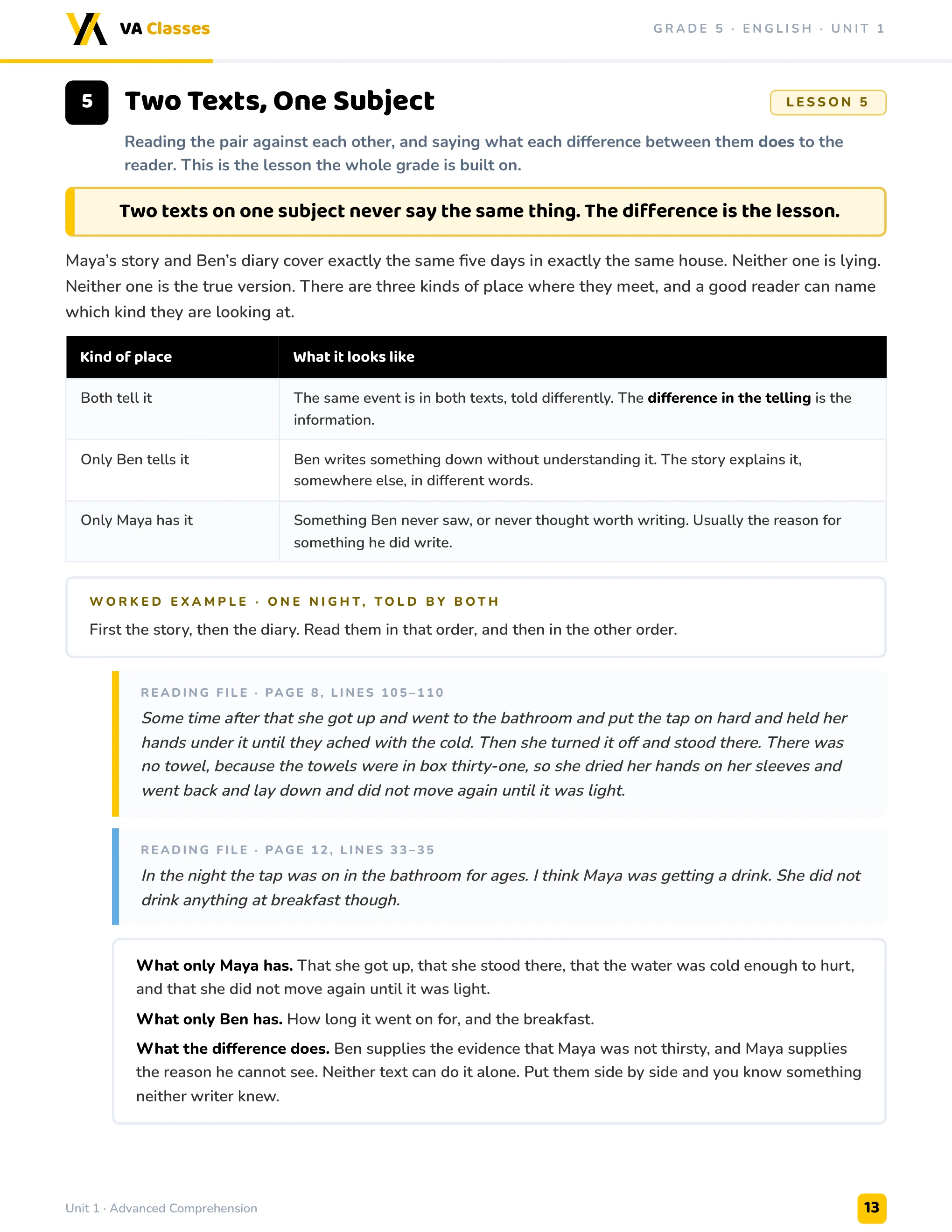
The Study Book cover of the Grade 4 Science pack

Grade 4 · Science

Grade 4 Science

A full year of Grade 4 science: habitats, light and sound, pulleys and gears, rocks and minerals.

7 units27 documents191 pages25 lessons
  • Scientific methods, variables, and reading your own results
  • Habitats and communities, and what happens when one part changes
  • Light and sound, as things that travel and can be measured
  • Pulleys and gears, and rocks and minerals and how they formed
Annual learning plan, free PDF
Every one of the 25 lessons, by unit
  1. Unit 1: Scientific MethodsQuestions you can test, Variables, Measuring properly, Tables and graphs, Evidence and conclusions
  2. Unit 2: Habitats and CommunitiesWhat a habitat provides, Adaptations, Food chains and food webs, Populations and communities, Human impact
  3. Unit 3: Light and SoundLight and how it travels, Shadows, Reflection, How sound is made, Pitch and volume
  4. Unit 4: Pulleys and GearsWhat a pulley is, Pulley systems, How gears work, Gear size and speed, Machines around you
  5. Unit 5: Rocks and MineralsRocks and minerals, Testing a rock, Three kinds of rock, Choosing the right rock, Taking it responsibly
  6. Unit 6: Review and Annual AssessmentReview and Annual Assessment
  7. Unit 7: Term and Year-End TestsTerm and Year-End Tests

CA$40once, and the whole year is yours
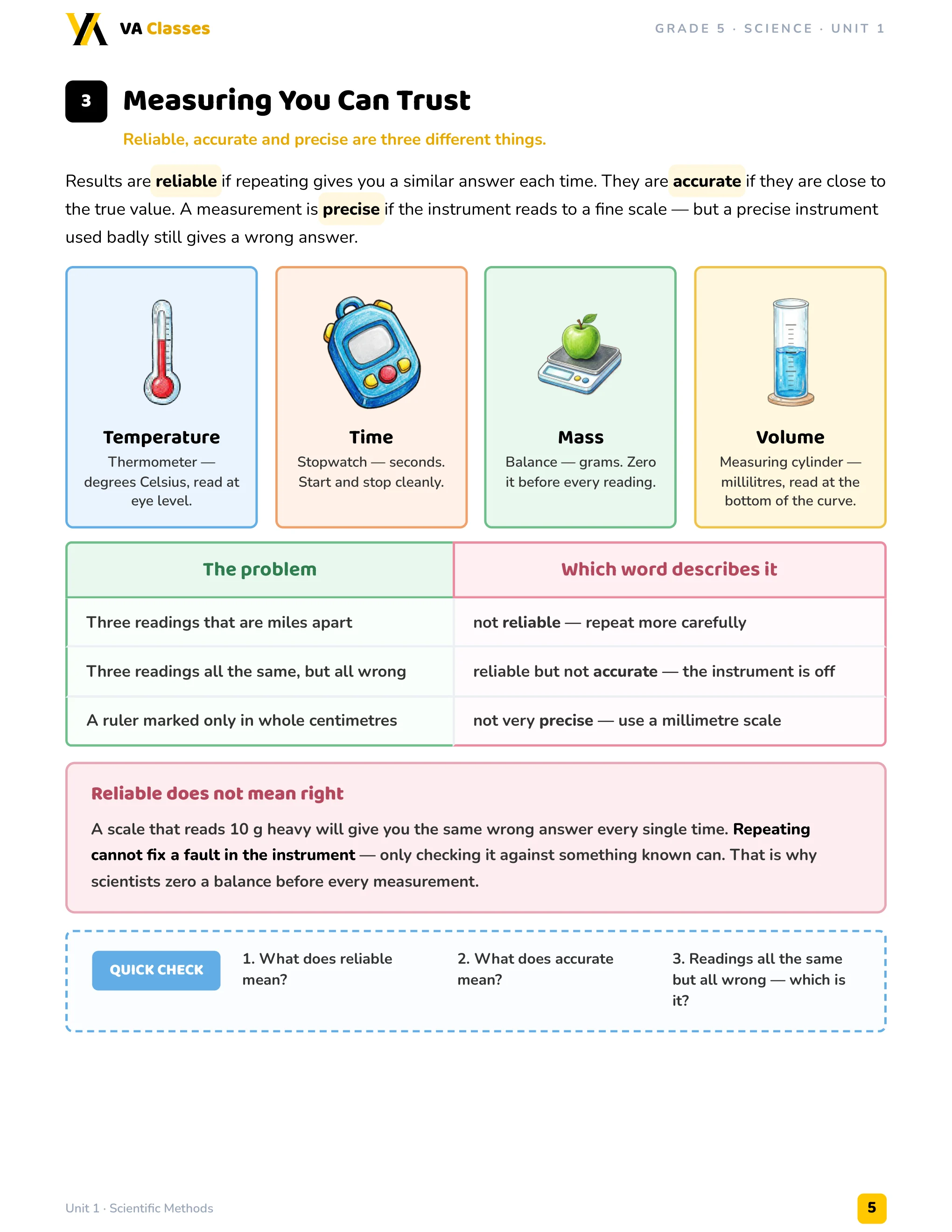
The Study Book cover of the Grade 5 English pack

Grade 5 · English

Grade 5 English

A full year of Grade 5 English, built on paired texts.

10 units50 documents1,006 pages90 lessons
  • Advanced comprehension across two texts on the same subject
  • Grammar, conventions, vocabulary and word roots
  • Multi-paragraph writing, narrative craft, and a research report
  • Poetry, a novel study, and functional writing such as letters and instructions
Annual learning plan, free PDF
Every one of the 90 lessons, by unit
  1. Unit 1: Advanced ComprehensionReading Twice, Inference That Is Anchored, Summarising Without Retelling, What the Writer Chose, Two Texts, One Subject, Fact, Opinion and Between, Reading Non-Fiction Hard, Questions Worth Asking, Putting It Together
  2. Unit 2: Grammar and ConventionsClauses, Phrases Are Not Clauses, Moving the Clause, Joining Well, Punctuation at Clause Level, Holding Tense and Person, Formal and Informal, Editing Somebody Else, Editing Your Own
  3. Unit 3: Vocabulary and MorphologyWords Carry Feeling, Choosing the Precise Word, Greek and Latin Roots, Prefixes That Point, Suffixes and Word Families, Register, Figurative and Literal, Dictionary and Thesaurus, A Working Word Bank
  4. Unit 4: Multi-Paragraph WritingWhat a Paragraph Does, The Topic Sentence, Evidence and Explanation, Ordering Your Reasons, Introductions, Joining Paragraphs, Conclusions That Do Work, Planning First, Revising, Not Correcting
  5. Unit 5: Narrative CraftCharacter Wanting Something, Revealed by Choice, Dialogue With Two Jobs, Setting as Pressure, Structure, Show, Do Not Tell, Pace, Revising for Effect, Finishing
  6. Unit 6: Reports and ResearchWhat a Report Does, A Question You Can Answer, Finding and Choosing Sources, Judging a Source, When Two Sources Disagree, Notes in Key Words, Your Own Words, and Where It Came From, Headings and Features, Writing the Report
  7. Unit 7: Poetry and Figurative LanguageWhat Verse Does, Metaphor Sustained, Personification With a Purpose, Imagery, Precisely, Sound, Line, Stanza, White Space, One Subject, Two Forms, Reading Aloud, Writing With Intent
  8. Unit 8: Novel StudyReading a Long Book Well, Character at the Start, Change Traced to Moments, A Character Who Speaks Little, Setting as Meaning, Theme, Two Letters, One Writer, Personal Response, Argued, Writing a Book Response
  9. Unit 9: Functional Writing and PresentationsWho Is This For?, What Is It For?, Letters and Emails That Work, Instructions Somebody Can Follow, A Proposal, The Same Message, Two Readers, Planning a Talk From Notes, Delivering It, Feedback You Can Actually Use
  10. Unit 10: ReviewComprehension, Grammar, Vocabulary, Paragraphs, Narrative, Research, Poetry, The Novel, Real-Purpose Writing

CA$60once, and the whole year is yours
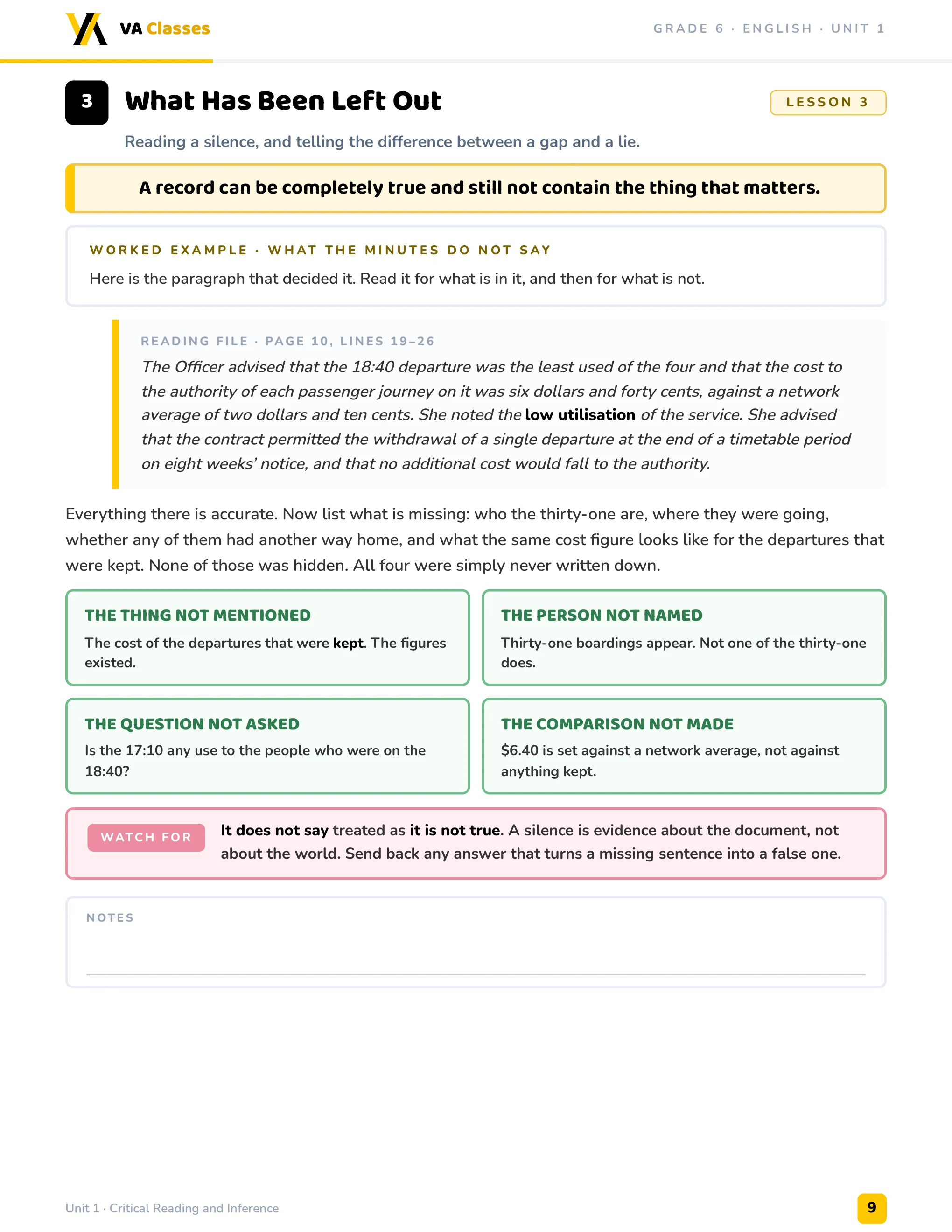
The Study Book cover of the Grade 5 Science pack

Grade 5 · Science

Grade 5 Science

A full year of Grade 5 science: the human body, matter, forces on structures and conserving energy.

7 units27 documents194 pages25 lessons
  • Scientific methods, and designing a test that answers the question asked
  • Human organ systems, and how one system depends on another
  • Properties and changes in matter, physical against chemical
  • Forces acting on structures, and conservation of energy and resources
Annual learning plan, free PDF
Every one of the 25 lessons, by unit
  1. Unit 1: Scientific MethodsHypothesis and prediction, Designing the investigation, Measuring you can trust, Working with your data, Concluding and evaluating
  2. Unit 2: Human Organ SystemsFrom cells to systems, The digestive system, The respiratory system, The circulatory system, Moving, sensing and working together
  3. Unit 3: Properties and Changes in MatterDescribing matter, Changes of state, Physical changes, Chemical changes, Separating mixtures
  4. Unit 4: Forces Acting on StructuresForces on a structure, Kinds of load, Shapes that are strong, Stability, Why structures fail
  5. Unit 5: Conservation of Energy and ResourcesForms of energy, Energy transformations, Wasted energy, Where our energy comes from, Conserving energy and resources
  6. Unit 6: Review and Annual AssessmentReview and Annual Assessment
  7. Unit 7: Term and Year-End TestsTerm and Year-End Tests

CA$40once, and the whole year is yours
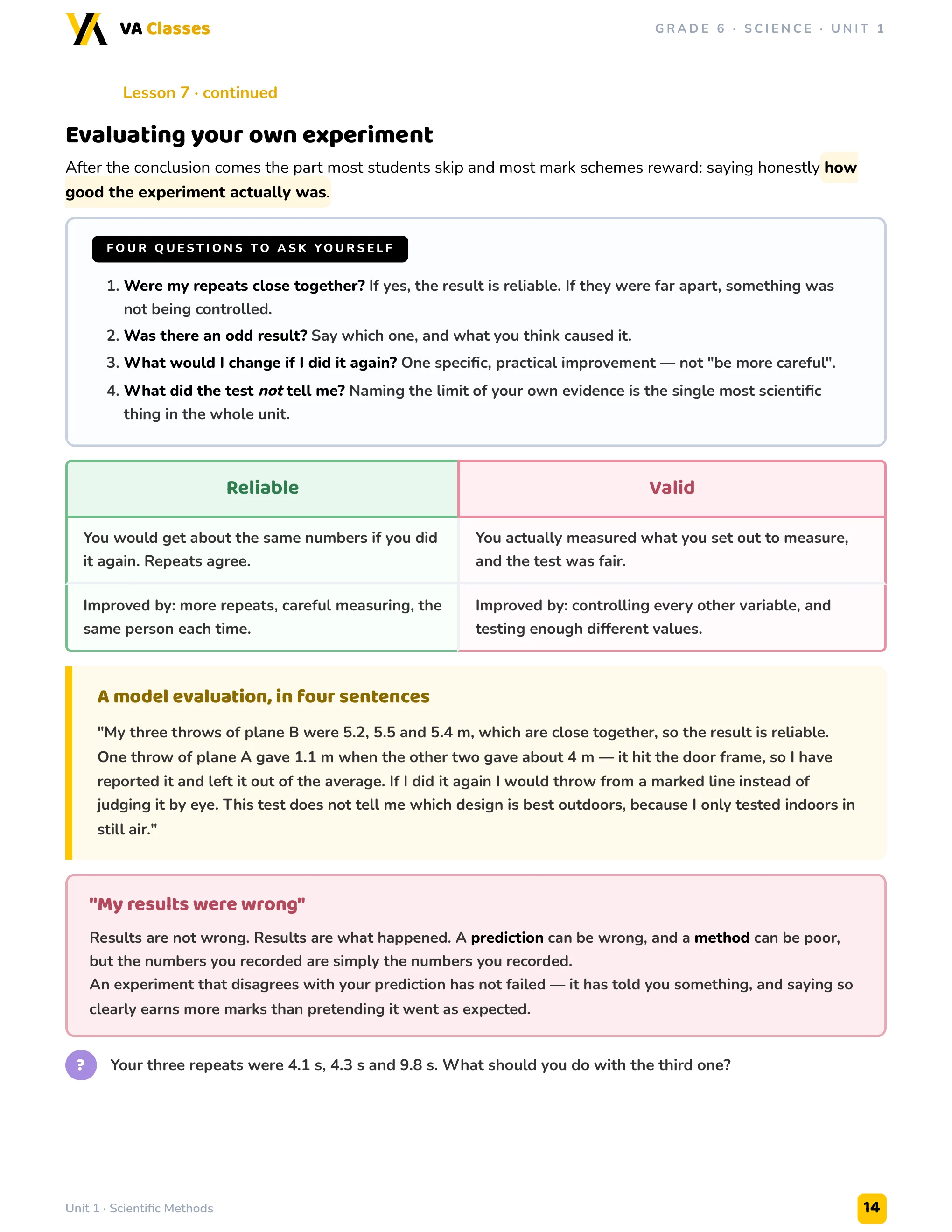
The Study Book cover of the Grade 6 English pack

Grade 6 · English

Grade 6 English

A full year of Grade 6 English: argument, sources and point of view.

10 units50 documents1,121 pages81 lessons
  • Critical reading and inference, and the difference between a fact, a topic and a claim
  • Grammar, sentence craft, punctuation, roots and word history
  • Argument and essay writing, narrative craft, point of view
  • Research and synthesis, poetry, a novel study, and media
Annual learning plan, free PDF
Every one of the 81 lessons, by unit
  1. Unit 1: Critical Reading and InferenceWhat Is Actually There, Inference in Three Steps, What Has Been Left Out, Whose Eyes, Tone, Fact, Opinion and Both, A Table and a Story, Three Sources at Once, Judging a Text
  2. Unit 2: Grammar, Sentence Craft and PunctuationPhrase or Clause, Where the Clause Sits, The Two Commas, Openers, Variety On Purpose, Active and Passive, Colon, Semicolon, Dash, Parenthesis, Proofreading Your Own
  3. Unit 3: Vocabulary, Roots and Word HistoryMorphemes, Greek Roots, Latin Roots, Prefixes and Suffixes, Denotation and Connotation, Choosing, and Defending It, Figurative Language, The Words That Carry the Task, Dictionary and Thesaurus
  4. Unit 4: Argument and Essay WritingWhat an Argument Is, The Thesis Statement, Reasons, and Their Order, Evidence, and Who Counted It, Explanation, The Counter-Argument, The Rebuttal, Openings, Endings, Joins, Planning, Revising, Tone
  5. Unit 5: Narrative Craft and Point of ViewWho Is Telling It, The Narrator Who Does Not Know, Character, Shown by a Cost, Dialogue, and What Is Under It, Setting as Pressure, Where to Begin, What to Cut, Pace, Revising, and Recording It, Endings That Do Not Explain
  6. Unit 6: Research, Sources and SynthesisA Question You Can Answer, Who Made It, and What They Do, Five Questions for a Source, Fact, Claim and the Step, Notes in Your Own Words, When Sources Disagree, Saying Where It Came From, Organising a Report, Writing It, and Checking It
  7. Unit 7: Poetry and Figurative LanguageThe Line, and the Break, Stanza and Shape, Imagery, Metaphor, Carried, Sound, Tone and Mood, Shifting, The Speaker Is Not the Poet, Comparing Two Poems, Writing and Revising
  8. Unit 8: Novel StudyWhat a First Chapter Does, The Narrator You Cannot Trust, Character, Relationships, Setting as Pressure, Turning Points, Theme, Not Topic, Arguing a Theme, Personal and Critical
  9. Unit 9: Media, Audience and PresentationPurpose, Audience, Form, How a Message Is Built, Technique, and What It Does, Who Is Missing, Register, Chosen, Writing That Has to Work, Instructions, Planning a Talk, Speaking and Listening
  10. Unit 10: The Year in Nine TextsRevisits Units 1 to 9

CA$60once, and the whole year is yours
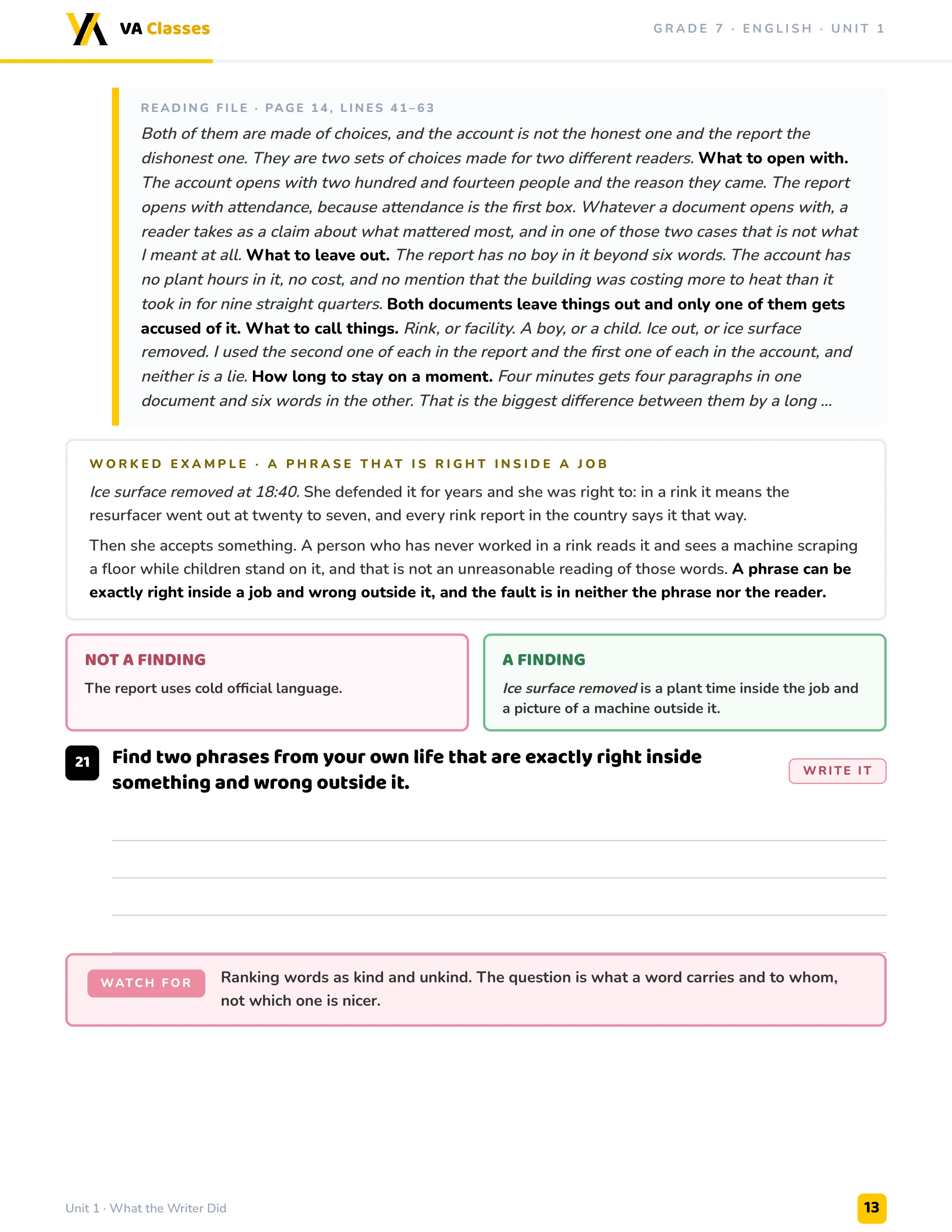
The Study Book cover of the Grade 6 Science pack

Grade 6 · Science

Grade 6 Science

A full year of Grade 6 science: biodiversity, electricity, flight and space.

7 units27 documents285 pages40 lessons
  • Scientific methods, and evidence that is strong enough to use
  • Biodiversity, and why losing one species matters
  • Electricity, circuits, and what a circuit diagram is really saying
  • Flight, the four forces, and space beyond what can be seen
Annual learning plan, free PDF
Every one of the 40 lessons, by unit
  1. Unit 1: Scientific MethodsTurn a vague question into one that can be tested, Tell an observation apart from an inference, Measure accurately and choose the right unit and the..., Design a fair test, Record results in a table and show them on a graph, Write a conclusion that is supported by the evidence -..., Work safely and assess the risk before starting, Explain why scientific knowledge changes
  2. Unit 2: BiodiversityExplain what biodiversity means at three levels -..., Sort living things into groups using distinguishing..., Say why variety inside one species is what keeps that..., Explain resilience: why a community with many kinds of..., Describe interrelationships - predator and prey, Explain how invasive species and climate change each..., Describe why biodiversity matters to agriculture, Assess the benefits of biodiversity and the...
  3. Unit 3: ElectricityExplain the difference between static electricity and..., Build a working circuit and explain why it only works..., Draw a circuit properly using standard symbols, Test materials and sort them into conductors and..., Describe how a series circuit and a parallel circuit..., Explain what an electrical device really does - it..., Describe how electricity is generated, Use electricity safely
  4. Unit 4: FlightGive evidence that air is a real substance that takes..., Explain air resistance, Name and describe the four forces of flight and say..., Explain how the shape of a wing produces lift, Compare lighter-than-air flight with heavier-than-air..., Explain how thrust is produced by a propeller, Describe how living things and even seeds use the same..., Design a fair test
  5. Unit 5: SpaceExplain day and night using the Earth’s rotation, Explain the seasons using the Earth’s tilt - not its..., Describe and order the phases of the Moon and explain..., Explain eclipses and tides, Describe the solar system and compare the inner and..., Explain what a star is, Explain how telescopes and space technology extend..., Assess the benefits and costs of space exploration
  6. Unit 6: Annual ReviewAnnual Review
  7. Unit 7: Term and Year-End TestsTerm and Year-End Tests

CA$40once, and the whole year is yours
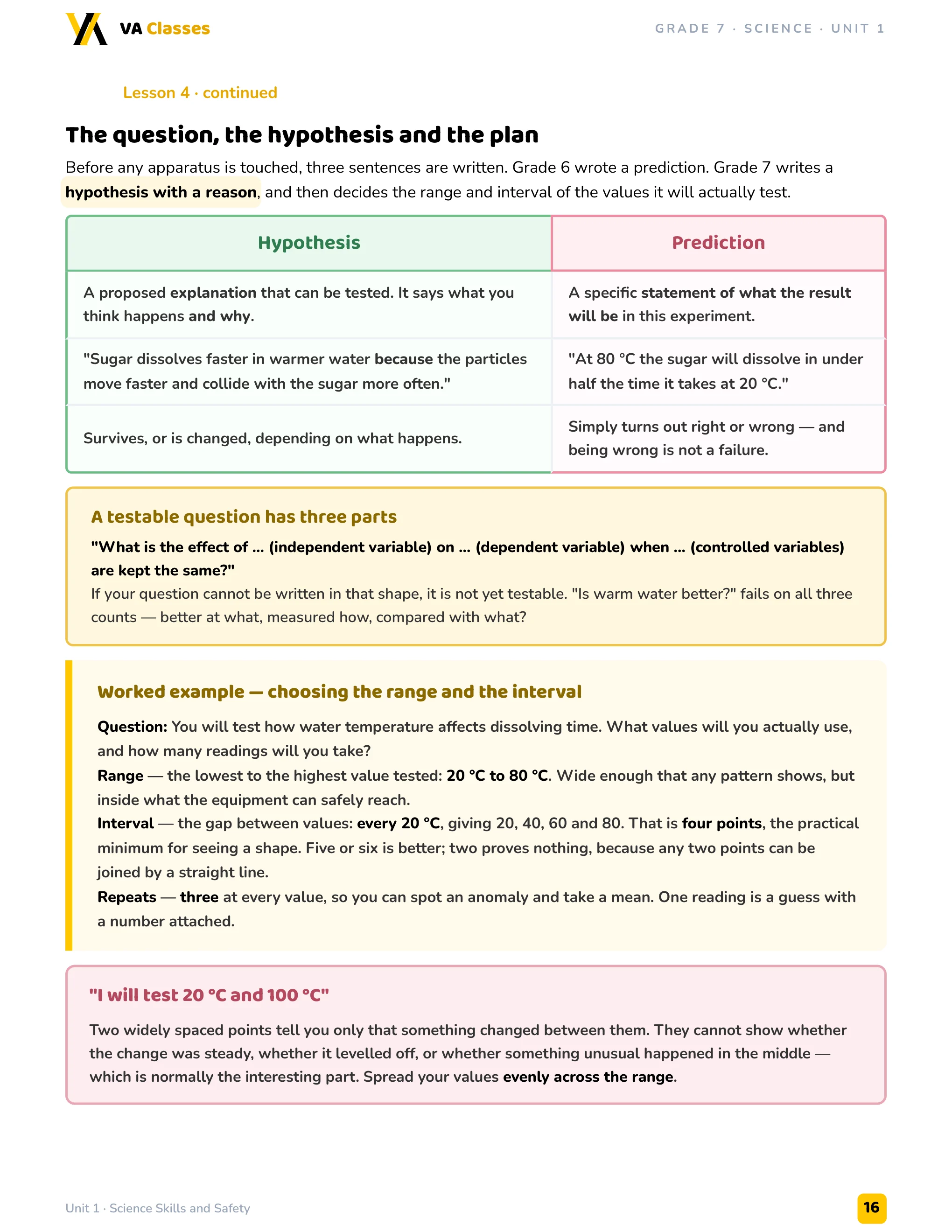
The Study Book cover of the Grade 7 English pack

Grade 7 · English

Grade 7 English

A full year of Grade 7 English, taught as a series of choices a writer made.

10 units50 documents1,174 pages90 lessons
  • What the writer did: technique named, found in the text, then used in the student's own writing
  • The paragraph that holds, word choice, and what a word carries
  • Taking a position, who is telling it, and where it came from
  • Poetry as a set of decisions, a longer story, and the same event told for different reasons
Annual learning plan, free PDF
Every one of the 90 lessons, by unit
  1. Unit 1: What the Writer DidOn the Page, or Supplied, The Five Choices, What Was Left Out, What Goes First, What Things Are Called, How Much Room, Who May Speak, An Accurate False Document, Write the Same Ten Minutes Twice
  2. Unit 2: The Paragraph That HoldsName the Job in Six Words, The First Sentence Is a Promise, The Order Inside a Paragraph, The Seven Small Words, The Close That Is Not a Repeat, What Bullets Cannot Do, Where a New Paragraph Starts, Two Paragraphs, Two Jobs, Four Paragraphs With Jobs
  3. Unit 3: Word Choice and What It CarriesWhat a Word Carries, The Four Pairs, Cold, Warm, Hot, Taking a Long Word Apart, The Suffix With No Person In It, Where a Word Came From, What a Word Costs, What Cooling It Did, One Paragraph, Three Ways
  4. Unit 4: Taking a PositionA Claim, Not a Subject, Reasons That Are Not the Claim, Where the Number Came From, Naming the Objection, Four Named Faults, What the Form Took Out, Reading a Source With a Footer, Which Reason Goes First, The Whole Piece on One Page
  5. Unit 5: Who Is Telling ItFirst Person, Third Person, Saw, or Concluded, At the Time, and Nine Years On, Five Things a Narrator Cannot Do, The Gap, A Guess Wearing a Fact's Coat, A Document With No Narrator, Character Out of What People Do, One Scene, Two Points of View
  6. Unit 6: Where It Came FromA Fact, and an Account of One, How Do They Know?, What Makes a Source Primary, The Source That Limits Itself, The One You Reject, A Number With No Origin, What a Chart Decides for You, What Taking the Doubt Out Did, Judge Four Sources of Your Own
  7. Unit 7: Poetry - The Line as a ChoiceWhere the Break Went, The Poem and Its Paragraph, Metre on Your Hand, Rhyme Is a Promise, A Shape That Means Something, The Thing, Not the Feeling, The Working Page, Form and Protocol, Break Your Own, Twice
  8. Unit 8: A Longer StoryWhat a Chapter Is For, A Theme Is Arguable, Character Out of Action, The Small Thing, What the Summary Loses, A Document Inside a Story, Setting Doing Work, The Chapter That Changes One, Write a Chapter With a Job
  9. Unit 9: The Same Thing, Told for a ReasonThe Four Questions, at Speed, Who Is Each One For, What a Poster Cannot Say, What a Table Decides, One Fact, Four Jobs, What the Plain Account Is For, The One Who Read All Three, Writing for a Named Reader, One True Thing, Three Ways
  10. Unit 10: ReviewWhat a Form Cannot Hold, Shape Is Not Decoration, What a Word Decides, Naming What Is Against You, What a Narrator Can Reach, How Do They Know, A Quarter of a Second, What a Chapter Is For, Who Is It For

CA$60once, and the whole year is yours
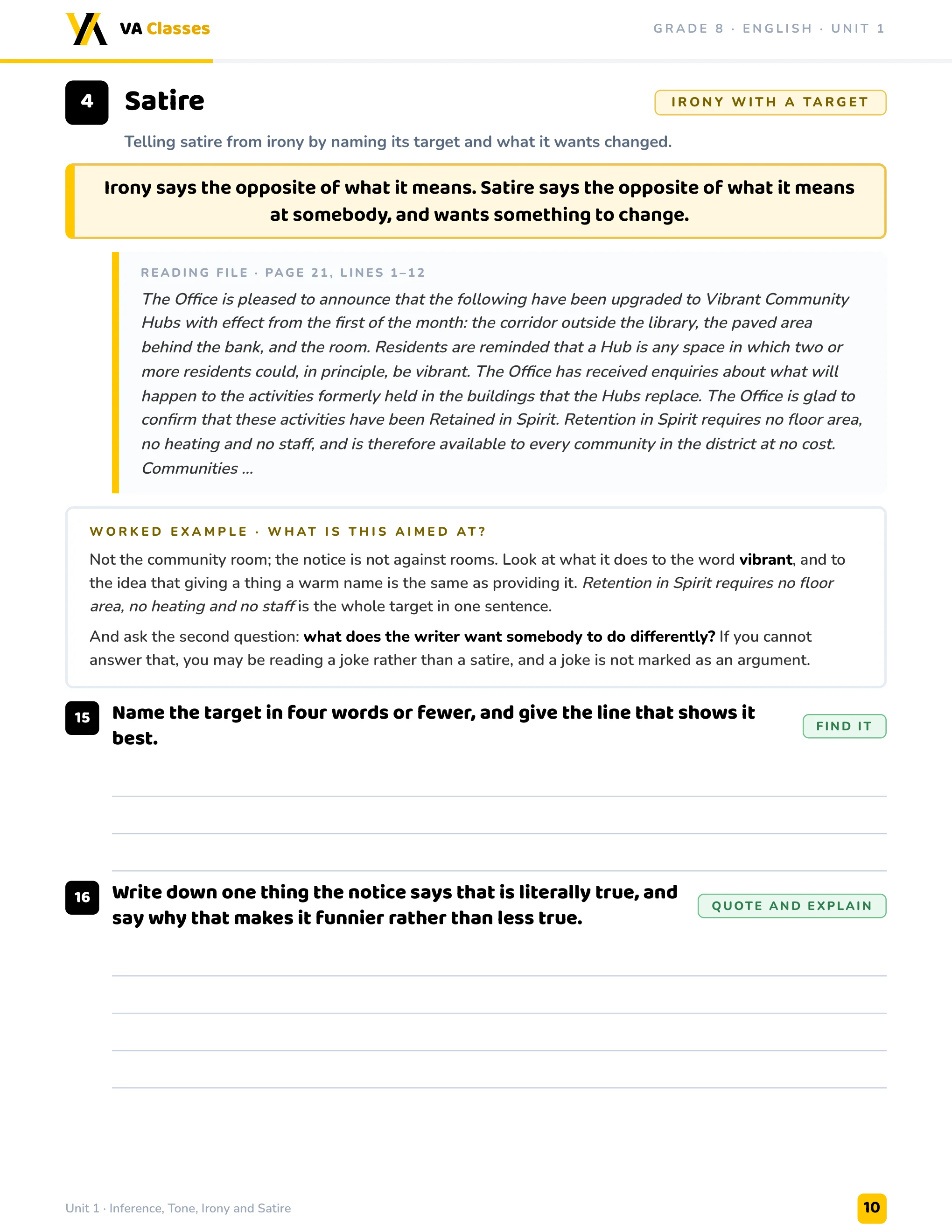
The Study Book cover of the Grade 7 Science pack

Grade 7 · Science

Grade 7 Science

A full year of Grade 7 science: ecosystems, pure substances and mixtures, form and function, and heat.

7 units27 documents464 pages45 lessons
  • Science skills and safety, and writing a method somebody else could follow
  • Interactions in the environment, and the effect of a change further down the chain
  • Pure substances and mixtures, separation, and solubility
  • Form and function in structures, and heat in the environment
Annual learning plan, free PDF
Every one of the 45 lessons, by unit
  1. Unit 1: Science Skills and SafetyCarry out a risk assessment, Name the standard laboratory equipment, Measure in the correct SI unit, Find a volume by displacement and calculate density, Write a hypothesis with a reason, Record and process data - means, Draw a line graph properly, Tell reliability from validity and random error from..., Answer to the command word
  2. Unit 2: Interactions in the EnvironmentSeparate the biotic and abiotic parts of an ecosystem, Use a quadrat to sample an area and estimate a..., Classify organisms as producers, Read and build a food web, Explain why energy runs out up a food chain, Describe the water, Explain limiting factors and carrying capacity, Analyse human impact - habitat loss, Evaluate a proposal for stewardship and sustainability
  3. Unit 3: Pure Substances and MixturesTell a pure substance from a mixture, Use the particle theory to explain solids, Explain every change of state, Use solute, Explain solubility, Calculate a concentration in g/l and compare two solutions, Separate mixtures by filtration, Choose the right separation method for a given mixture, Explain how drinking water is treated
  4. Unit 4: Form and FunctionClassify a structure as solid, Name the external forces on a structure and tell a..., Measure a force in newtons with a spring balance, Identify tension, Explain why the triangle is rigid, Use centre of gravity and base area to explain and..., Choose a material for a job using strength, Name the five ways structures fail, Run a fair load test with repeats
  5. Unit 5: Heat in the EnvironmentUse temperature, Explain heating and cooling with the particle theory..., Explain expansion and contraction, Explain conduction with particles, Explain convection using density, Explain radiation, Plot and read a cooling curve, Explain how a vacuum flask defeats all three transfers..., Explain the greenhouse effect properly
  6. Unit 6: Review and Annual ExamReview and Annual Exam
  7. Unit 7: Term and Year-End TestsTerm and Year-End Tests

CA$40once, and the whole year is yours
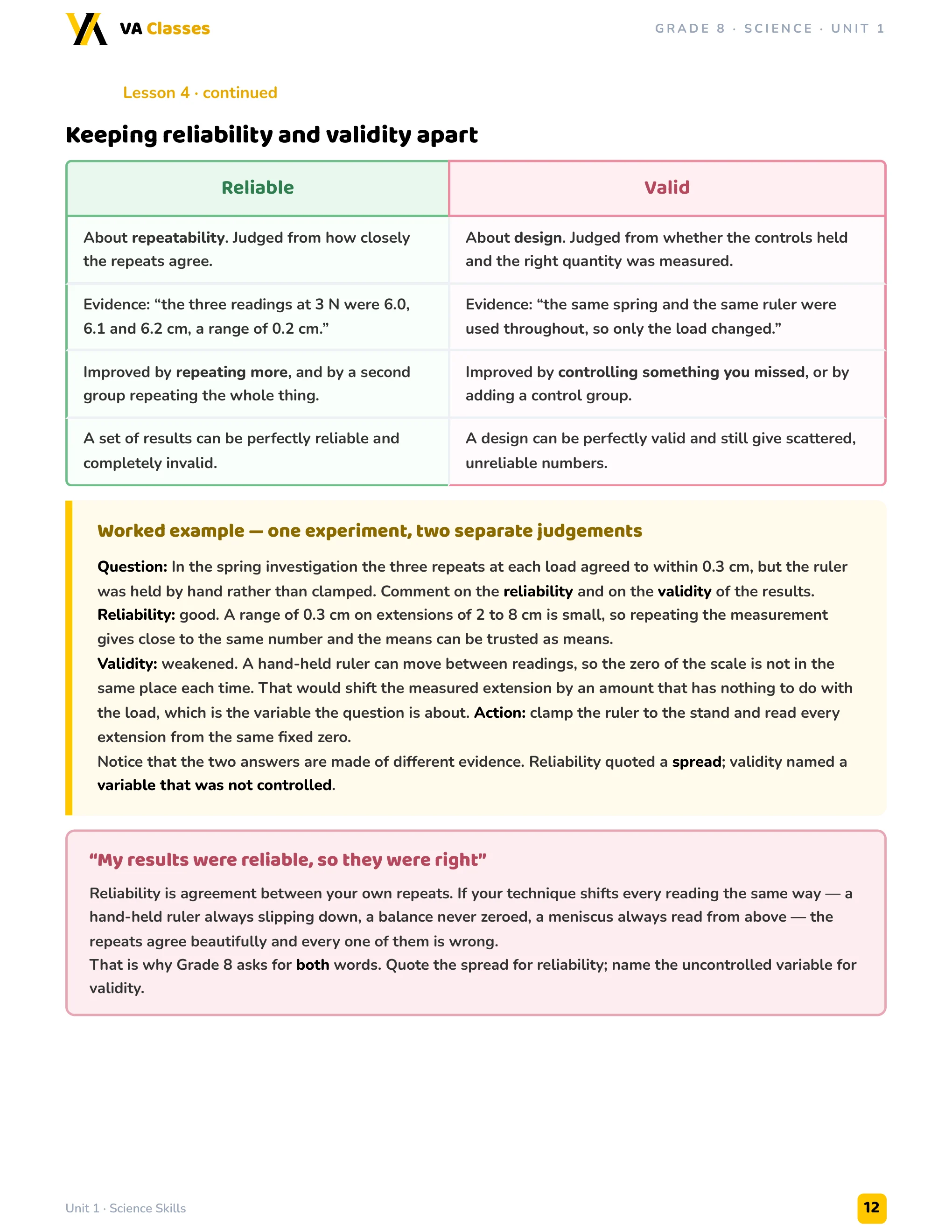
The Study Book cover of the Grade 8 English pack

Grade 8 · English

Grade 8 English

A full year of Grade 8 English: tone, irony, argument and judging a source.

10 units50 documents1,224 pages90 lessons
  • Inference, tone, irony and satire
  • The controlled paragraph, registers, and loaded language
  • Concession and refutation, voice, reliability and point of view
  • Finding and judging your own sources, poetry as form, a novel study with a second text, and how media reached you
Annual learning plan, free PDF
Every one of the 90 lessons, by unit
  1. Unit 1: Inference, Tone, Irony and SatireWhat the Words Say, Tone, Irony, Satire, Allusion, The Sincere One, A Document That Is Selling, The Source You Reject, Two Texts in Dialogue
  2. Unit 2: The Controlled ParagraphWhat a Paragraph Is For, The First Sentence, What a Transition Claims, Where the Weight Sits, Narrative Against Argument, Cohesion, Hard on Purpose, Order, Rebuilding
  3. Unit 3: Words, Registers and Loaded LanguageDenotation and Connotation, The Three Defences, Register, Loaded Language, Roots, A Word That Changed, Cultural Elements, Two Texts in Dialogue, Three Registers
  4. Unit 4: Concession and RefutationA Claim, Not a Topic, The Objection, in Its Own Best Words, Concession, Refutation, Five Named Faults, Where the Evidence Came From, The Source You Reject, Where the Objection Sits, The Whole Essay on One Page
  5. Unit 5: Voice, Reliability and Point of ViewWho Is Telling This, Accurate and Wrong, Dramatic Irony, The Signals, The Second Text, A Document About a Person, The Chain, Two Texts in Dialogue, One Event, Two Voices
  6. Unit 6: Finding and Judging Your Own SourcesPrimary, Secondary, Interested, How Do They Know?, The Four Things, Rejecting a Source, Two Readings, Attribution Inside, The Source List, A Source Against Itself, Your Own Set
  7. Unit 7: Poetry - Form as ArgumentWhat a Form Claims, The Line Break, Sound as Meaning, The Turn, Free Verse, Across Time and Place, A Told Story, The Poems and the Note, One Poem, Two Forms
  8. Unit 8: Novel Study and a Second TextThe Opening, Character, Structure, Theme, The Question It Refuses, Reading the Ledger, The Second Text, The Comparative Paragraph, The Comparative Essay
  9. Unit 9: Media, Attention and How It Reached YouThe Four Questions, How It Reached You, What Changed at Each Step, Framing, The Headline, Attention, The Publicist, Read Fairly, Two Texts in Dialogue, Writing With a Job to Do
  10. Unit 10: Review of the Whole CourseWhat Is It Doing?, Shape Is the Argument, The Temperature of a Word, Concede It Properly, Saw, or Concluded?, How Do They Know?, What the Form Did, A Theme Is Disputable, How Did It Reach Me?

CA$60once, and the whole year is yours
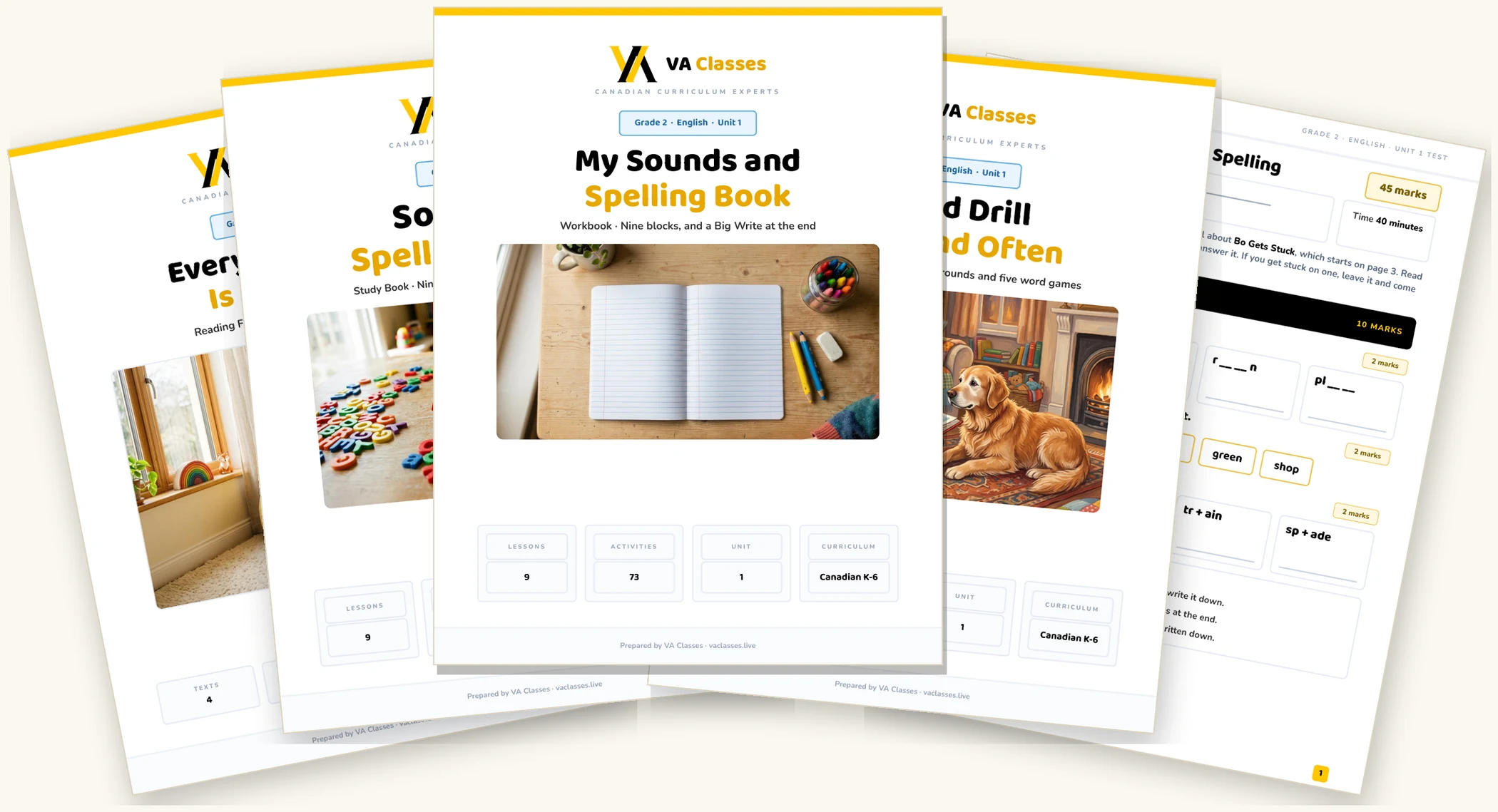
The Study Book cover of the Grade 8 Science pack

Grade 8 · Science

Grade 8 Science

A full year of Grade 8 science: cells, fluids, systems in action and water systems, with a Grade 9 readiness check.

7 units28 documents516 pages46 lessons
  • Science skills, variables, and handling real measurements
  • Cells, their parts, and what each part is for
  • Fluids, density, viscosity and pressure, with the calculations worked through
  • Systems in action and water systems, plus a Grade 9 readiness assessment with a roadmap of what to fix
Annual learning plan, free PDF
Every one of the 46 lessons, by unit
  1. Unit 1: Science SkillsExplain why the method decides the answer, Tell a control group from a controlled variable - the..., Record a reading as ± half the smallest division and..., Keep accuracy, Design a results table with repeats in their own columns, Choose between a bar chart, Calculate a gradient as rise ÷ run, Separate random from systematic error, Write a conclusion and a separate evaluation
  2. Unit 2: CellsName every part of a compound light microscope, Calculate total magnification as eyepiece × objective, Use actual size = image size ÷ magnification, State the three parts of cell theory and give the..., Name every organelle in a plant and an animal cell..., Explain diffusion and osmosis as movement down a..., Calculate a surface area to volume ratio, Tie the shape of five specialised cells to the job..., Answer to the command word - analyse
  3. Unit 3: FluidsExplain, Define viscosity as internal friction, Calculate density from ρ = m ÷ V, and rearrange it to..., Find the volume of an irregular solid by displacement, State Archimedes’ principle - the buoyant force equals..., Explain how a submarine, Calculate pressure from p = F ÷ A in pascals, Explain the hydraulic multiplier, Evaluate a real decision about moving fluids - a...
  4. Unit 4: Systems in ActionDescribe any system as input, Calculate work from W = F × d in joules, Name the six simple machines and say which force each..., Identify a first, Calculate mechanical advantage two ways - from forces..., Work out a gear ratio from the teeth, Calculate efficiency as a percentage, Explain how hydraulic and pneumatic systems do work, Evaluate a decision to replace a human task with a machine
  5. Unit 5: Water SystemsState how Earth’s water is divided - 97.5% salt, Name every stage of the water cycle and say which of..., Use watershed, Describe an aquifer, Explain how differences in temperature and salinity..., Explain how a glacier forms and moves, Interpret dissolved oxygen, Calculate a flow rate from a volume and a time, Put the five treatment stages in order and say what..., Evaluate a real water decision
  6. Unit 6: Review and Grade 9 ReadinessReview and Grade 9 Readiness
  7. Unit 7: Term and Year-End TestsTerm and Year-End Tests

CA$40once, and the whole year is yours
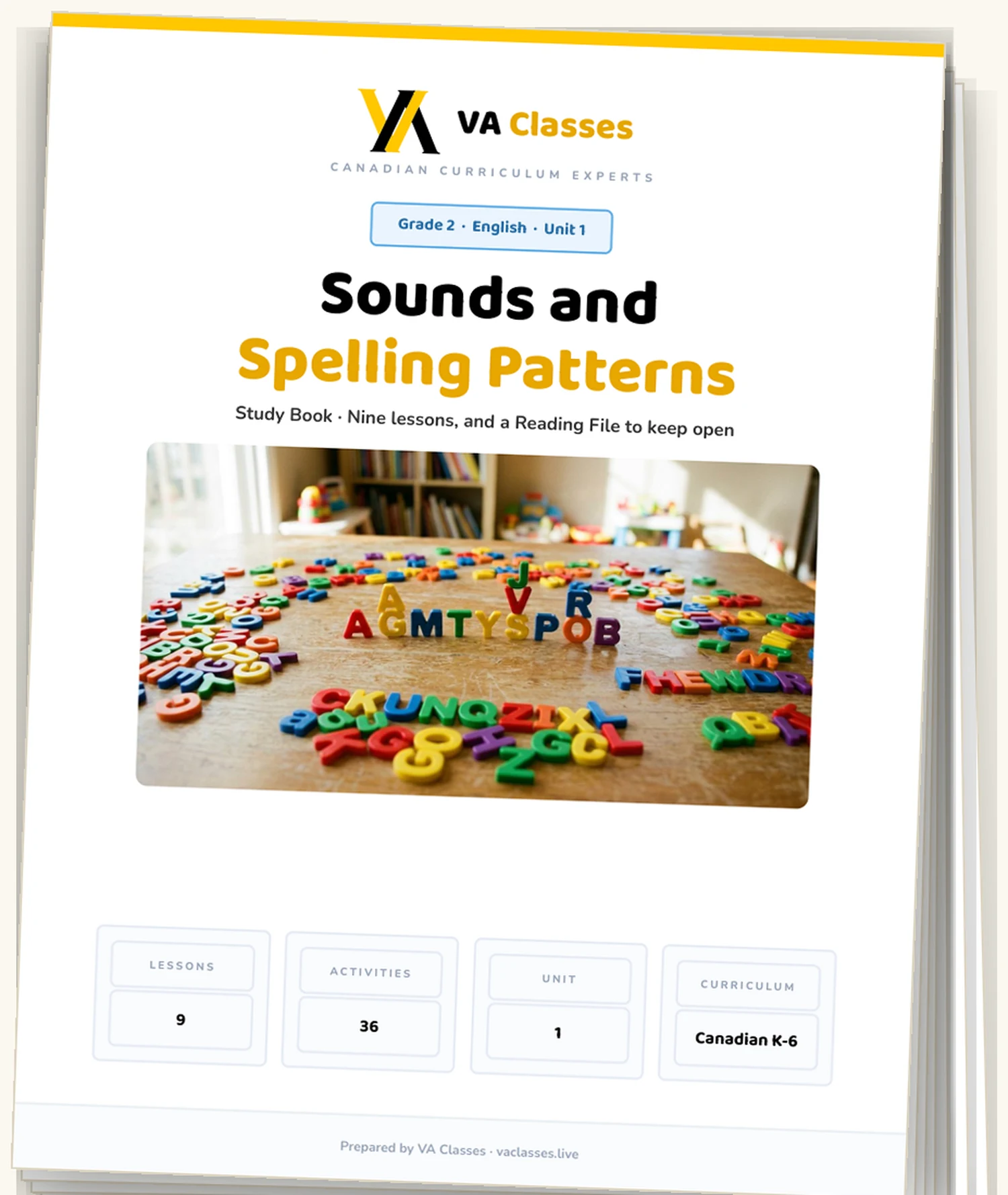
  • Download straight away
  • Print at home, letter size
  • No subscription, yours to keep
  • Charged in US dollars, US$29 or US$43 by course, about CA$40 or CA$60 at today's rate

The same shape, every unit

The same documents, every single unit

A child always knows where they are, and you always know what comes next.

The five documents of Unit 1 of the Grade 2 English pack, side by side: the Reading File, Study Book, Workbook, Skills Drill and Unit Test

Reading File

The passages and texts for the unit, printed in full. English courses only.

Study Book

The teaching. One idea per lesson, a picture, a worked example and the words to say.

Workbook

The practice, in the order the Study Book taught it.

Skills Drill

Short repetition, so the skill becomes quick rather than remembered. Called the Language Lab in the older English grades and the Drill Book in Math and Science.

Unit Test

One test at the end of every unit, and a full assessment at the end of the year.

There are no answer keys in here, and that is deliberate.

A child who can see the answer stops working out the question. The working is the entire point of a workbook, and an answer printed at the bottom of the page removes it.

Marking guides do exist for every one of these courses. They stay with the tutor. So if you want the work marked, or somebody to sit with your child and go through what went wrong, that is a class rather than a pack.

One tutor, one student, and the first class is free.

A stack of printed pages from a VA Classes pack

Before you buy

Straight answers

That is what the Study Book is for. Each lesson is one idea, a picture, a worked example and the words to say. You read that, then your child does the Workbook page that follows it. The tutor boxes tell you what children usually get wrong on that page, before it happens.

Start with the free unit.

Pick your child's grade above and the first unit is emailed to you. If the explaining is the part you would rather not do, book a free class instead.

See all 18 courses