 VA Classes
Friction
Friction is not a nuisance that spoils experiments. Without it you could not walk, hold a pencil or stop a bicycle, and half of what it does is the half nobody notices.
What friction is
Friction is a force between two surfaces that are touching, and it always pushes against the movement.
Two things matter in that sentence and children usually take only the first. Friction needs surfaces in contact, so it is not something an object carries around with it. And it always opposes the motion, which means it points backwards when you are going forwards and forwards when you are going backwards. It never helps you along.
Zoom in far enough on any surface, even one that feels perfectly smooth, and it is covered in bumps. Two surfaces sliding past each other have to drag those bumps across one another, and that dragging is what we call friction.
Rough against smooth
Let the same crate go from the same place on the same slope, twice, and change nothing except the floor it lands on. Both runs are drawn below, one above the other, measured from the same line, so you can see the difference rather than having to remember it.
Nothing about the crate changed between the two runs. Same weight, same shape, same everything.
Let go from the same spot both times, so the crate reaches the bottom with the same amount of movement.
The floor. That is what makes it a fair test, and it is why the difference in distance can only be down to the surface.
Where does the movement go?
Energy is never destroyed, so the movement the block loses has to become something. It becomes heat, and a little sound.
Rub your hands together hard and you can feel it happening.
When friction is useful
School experiments usually treat friction as the thing that ruins a result, and that gives children a lopsided idea of it. Most of the time friction is the reason something works at all.
Four places you use it every day
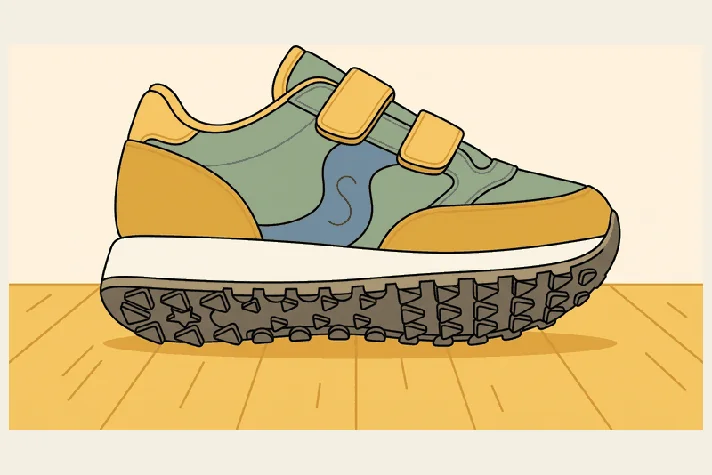
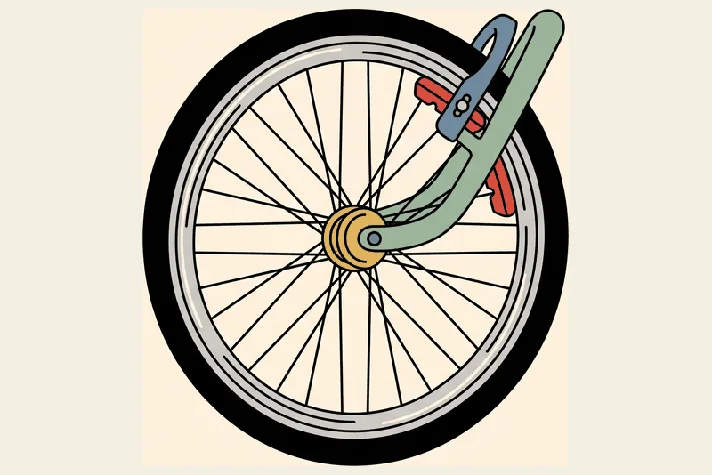
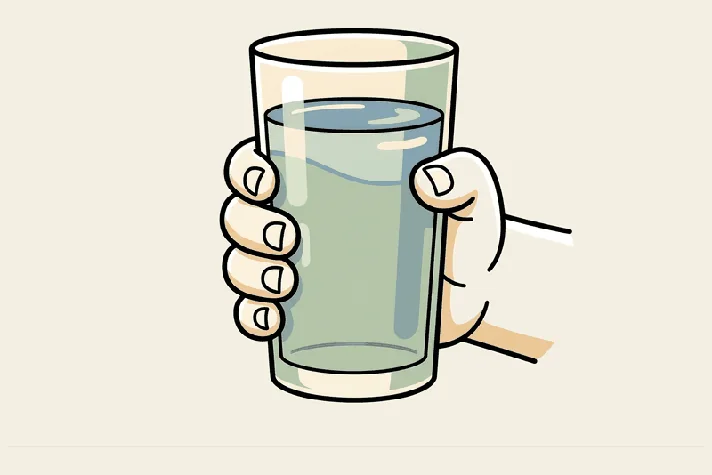
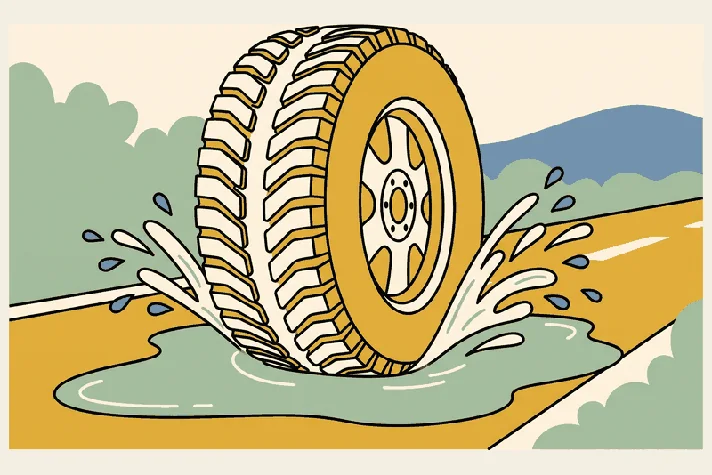
And when it is a nuisance, the usual answer is to put something slippery between the surfaces. Oil in an engine, wax on skis, grease on a bicycle chain: all of them are keeping two surfaces from touching properly.
Friction in air and water
Friction does not only happen between solids. Anything moving through air has to push the air out of the way, and the air pushes back. That is air resistance, and it is friction under a different name.
It is also why a parachute works. The canopy is enormous, so it has to shove a great deal of air aside, and the air resistance grows until it matches the parachutist's weight. Water does the same thing more strongly, which is why swimmers shave their heads and boats are pointed at the front.
Faster means more
Air resistance grows as you speed up. Put a hand out of a car window at 20 km/h and then at 80, and the difference is not small. That is why a falling object eventually stops speeding up.
Common mistakes
1. Saying friction is always bad
It is what school experiments teach by accident, because in a lab it usually is the thing spoiling the measurement. Ask how you would walk across a room with no friction at all and the other half of the story arrives immediately.
2. Thinking heavier objects always have more friction
Heavier usually does mean more friction, and the reason matters: it is because the surfaces are pressed together harder, not because heavy things are special. A light object pressed down firmly has more friction than a heavy one resting gently.
3. Believing the energy simply vanishes
A block slides, slows and stops, so where did the movement go? Into heat, and into a small amount of sound. Energy is never lost, only moved on, and friction is one of the commonest ways it gets moved into heat.
Practice questions
Seven questions. One attempt each, and the explanation appears once the answer is in.
Check yourself
No sign up. Nothing is sent anywhere, the score stays on this device.
What to learn next
Gravity is the other force in nearly every question on this topic, and mass and weight get mixed up constantly, so it is the natural next page.
Three surfaces, one coin
- Flick a coin across a kitchen worktop. Mark where it stops.
- Do it again across a tea towel, with the same flick.
- Do it a third time across a doormat.
Your child will predict the order correctly straight away. The useful half is asking them why, and then asking where the coin's movement went. It takes one minute and needs nothing you do not already own.
Keep going
Still stuck on this?
Send us the question and a teacher will answer it. No charge, and you do not have to be a student here.
What to learn next
Everything in the Learning Hub
Every topic is free and every one ends with practice questions. Start anywhere.
Fractions
Math · 9 topics
What Is a Fraction?Equivalent FractionsSimplifying FractionsComparing FractionsAdding and Subtracting Fractions With the Same DenominatorAdding Fractions With Different DenominatorsFinding a Fraction of a NumberMixed Numbers and Improper FractionsFractions to DecimalsDecimals and percentages
Math · 7 topics
What Are Decimals?Comparing and Ordering DecimalsAdding and Subtracting DecimalsRounding DecimalsWhat Are Percentages?Finding a Percentage of a NumberFractions, Decimals and PercentagesScience: matter and the water cycle
Science · 5 topics
What Is Matter?Solids, Liquids and GasesChanging StateThe Water CycleMixtures and SolutionsWhole numbers
Math · 10 topics
Place Value to 1,000,000Rounding Whole NumbersAdding and Subtracting With RegroupingTimes Tables That Actually StickMultiplying by 10, 100 and 1000Long Multiplication, Step by StepShort DivisionLong Division, Step by StepFactors, Multiples and PrimesOrder of OperationsForces and energy
Science · 6 topics
Forces and MotionFrictionGravity, Mass and WeightLevers and Simple MachinesEnergy and Its FormsSimple CircuitsEnglish: words and sentences
English · 6 topics
Nouns, Verbs and AdjectivesWhat Makes a Sentence, and What Does NotCapital Letters, Full Stops and CommasApostrophesVerb TensesSubject and Verb AgreementStuck on this topic? Get one class, free.
A tutor works through it live with your child, one on one, and sends you a short written report afterwards. No card needed.